Loading game
Preparing player
Loading game
Ready to play
Play Tekken 3, choose a classic fighter, sidestep attacks, mix punches and kicks, launch juggle combos, and battle through Namco’s 3D fighting game.
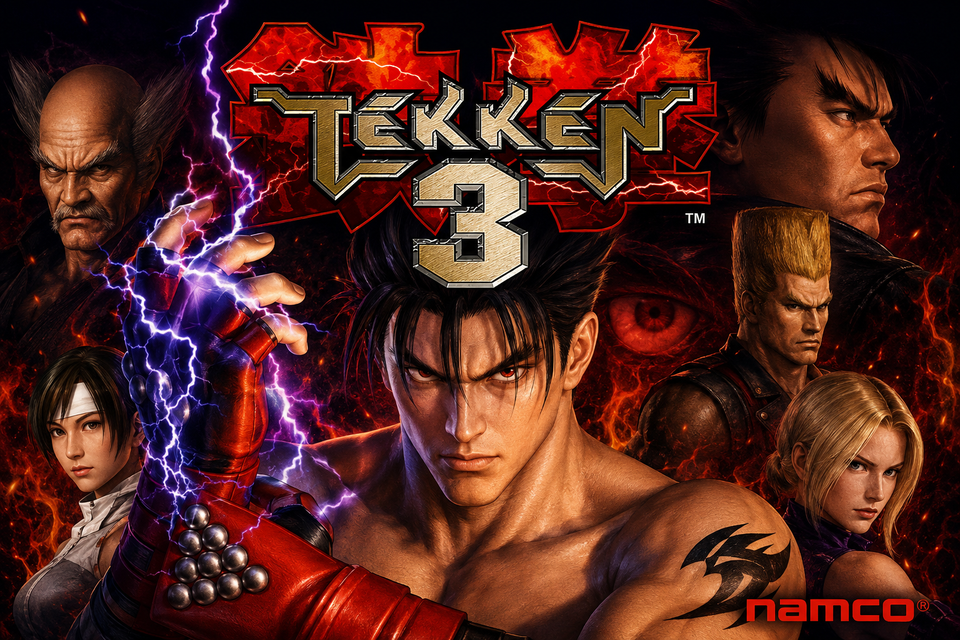
Tekken 3 is a 3D fighting game developed by Namco where you choose a fighter and battle opponents using punches, kicks, throws, sidesteps, launchers, and character-specific combinations. Unlike a simple button-mashing fighter, Tekken 3 rewards controlling distance, recognizing high and low attacks, moving around an opponent, and converting openings into damaging combos. It originally appeared in arcades in 1997 and was adapted for PlayStation in 1998.
Tekken 3 is the third main entry in the Tekken series. Its story takes place years after Tekken 2 and introduces a largely new generation of fighters alongside returning characters.
Important newcomers include Jin Kazama, Hwoarang, Ling Xiaoyu, Eddy Gordo, Bryan Fury, Julia Chang, and Mokujin. Returning fighters include characters such as Paul Phoenix, Nina Williams, Yoshimitsu, Lei Wulong, and Heihachi Mishima. Ogre and the transformed True Ogre serve as major opponents near the end of the main tournament progression.
One of Tekken 3's biggest gameplay changes is universal sidestepping. Fighters can move toward the foreground or background to avoid certain attacks and create new attack angles, giving the combat a stronger three-dimensional structure than earlier Tekken games.
The original control system uses directional movement together with four attack buttons. Tekken notation commonly represents these buttons as 1, 2, 3, and 4. Browser versions can assign the original controls to different keyboard keys depending on the emulator, so use the control mapping shown by the version you are playing.
| Input | Action |
|---|---|
| Directional Controls | Move, crouch, jump, dash, and reposition your fighter |
| 1 | Left Punch |
| 2 | Right Punch |
| 3 | Left Kick |
| 4 | Right Kick |
| Tap Up or Down | Sidestep toward the background or foreground |
This four-limb control system is central to Tekken. Individual characters combine directions and limb buttons into unique strings, special attacks, launchers, throws, stances, and other techniques.
Sidestepping is one of the defining mechanics of Tekken 3. A quick tap upward or downward moves your fighter away from the normal forward-and-backward line of combat.
This can help against attacks that travel directly forward. Instead of blocking every incoming strike, you may be able to move around it and attack the opponent from the side.
However, sidestepping is not an automatic defensive solution. Some attacks can track sideways or catch movement, so use it when you recognize a predictable linear attack rather than constantly stepping around the arena.
Understanding attack height is important because Tekken 3 does not use one defensive answer for every strike.
This creates a constant guessing game. If you rely only on standing defense, an opponent can attack your legs. If you crouch too frequently, a mid attack can punish that habit.
Certain attacks can launch an opponent into the air. Once airborne, the rival cannot immediately defend normally, giving you time to add follow-up strikes before they reach the ground.
Tekken 3 expanded the importance of juggling compared with earlier entries, with more attacks capable of starting airborne combinations.
You do not need a long combo to use this mechanic effectively. Begin by learning one reliable launcher and a short follow-up for your chosen fighter. A consistent three- or four-hit sequence is more useful than a complicated combo that you rarely complete.
Tekken 3's roster covers several very different approaches to combat. Jin Kazama provides a traditional martial-arts foundation, Hwoarang uses a Taekwondo style built around kicks and multiple stances, Eddy Gordo uses Capoeira, King specializes heavily in wrestling and throws, and Ling Xiaoyu relies on movement and distinctive stances.
For your first matches, choose one character and learn a small toolkit:
Once those actions become familiar, learning longer strings and more specialized techniques becomes easier.
The PlayStation version contains substantially more than the standard Arcade battles. Documented modes include Arcade, Versus, Team Battle, Time Attack, Survival, Practice, Tekken Force, and Tekken Ball.
Choose a fighter and battle through a sequence of opponents. This is the traditional tournament-style Tekken experience.
Two players can select fighters and compete directly against each other.
Practice gives you space to learn movement, experiment with command inputs, and become familiar with a character's attacks without progressing through the tournament.
Tekken Force changes the normal one-on-one structure into a side-scrolling beat-'em-up mode. You move through stages and fight groups of enemies rather than facing only a single opponent at a time.
Tekken Ball replaces normal direct combat with a large ball that players strike toward each other. Powerful attacks charge the ball, and damage can be caused through the ball rather than through ordinary fighting alone.
These additional modes belong to the PlayStation version. Browser releases based on a different Tekken 3 version may not contain every mode.
If an opponent uses a slow attack and misses, do not immediately respond with your most complicated move. Use a reliable attack that can connect before they recover. Consistent punishment makes reckless offense much less effective.
Repeating attacks at the same height makes defense easier. Use lows to challenge standing defense, then mix in mids when the opponent begins crouching.
If an opponent repeatedly uses straight attacks, try sidestepping rather than blocking everything. Moving around a predictable attack can leave you positioned beside the opponent for a counterattack.
After learning a launcher, find a dependable follow-up that you can execute consistently. Add additional hits only after the basic sequence feels reliable.
An opponent who remains close and waits for normal strikes can become vulnerable to throws. Mixing throws with punches, mids, and lows makes your offense harder to predict.
Long button strings are not automatically safe. If the opponent blocks your attack sequence, continuing may leave you exposed. Learn where your dependable strings end and return to movement or defense instead of always pressing another button.
If you enjoy Tekken 3's close-range fighting, combos, and head-to-head battles, try these combat games on YaloGames:
For another direct fighting experience, start with City Brawl or Tap Brawl. If you want a combat game with less traditional movement, Ragdoll Arena adds physics-based battles.
Namco developed and published Tekken 3. The arcade game arrived in 1997, followed by the PlayStation version in 1998.
Tekken uses one button for each limb: left punch, right punch, left kick, and right kick. They are commonly written as 1, 2, 3, and 4 in Tekken move notation.
Yes. Tekken 3 expanded sidestepping to the full cast. Tapping up or down and returning to neutral moves the fighter toward the background or foreground.
Tekken Force is a bonus mode in the PlayStation release that changes the usual one-on-one battles into side-scrolling fights against groups of enemies.
Tekken Ball is another PlayStation bonus mode where fighters use their attacks to strike a large ball and damage the opponent through it.
Tekken 3 becomes much easier to understand once you stop treating every fight as a race to press more buttons. Control your distance, learn the four-limb attack system, mix your attack heights, sidestep predictable pressure, and practice one reliable launcher combination. Once those fundamentals become consistent, the deeper character movesets, throws, stances, and longer combos give you many more ways to control each fight.
LIVE CHAT
No messages yet. Start the conversation.
Log in to join the chat.
Login