Loading game
Preparing player
Loading game
Ready to play
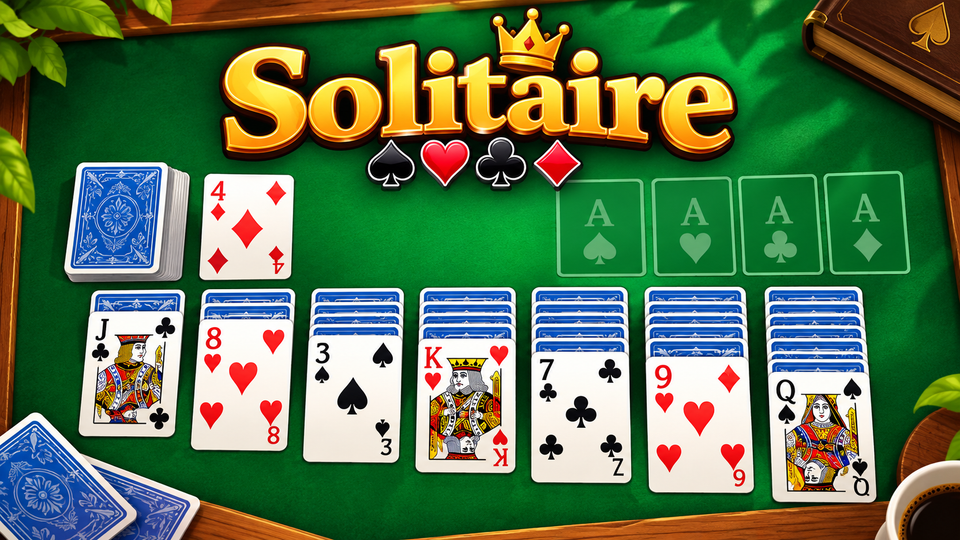
Solitaire is a classic card game where you uncover hidden cards, build alternating tableau sequences, and complete four suit foundations from Ace to King.
Solitaire is a single-player card game where you organize a standard 52-card deck by moving cards between seven tableau columns and four foundation piles. In the classic version commonly called Klondike Solitaire, your goal is to uncover every hidden card and build each foundation by suit from Ace through King. Browser versions typically let you move cards with simple clicks or drag-and-drop controls.
Although the word Solitaire can describe many one-player card games, Classic Solitaire and Klondike usually refer to the same familiar ruleset. The challenge comes from deciding which cards to uncover first, when to draw from the stock, and how to arrange the tableau without blocking cards you will need later.
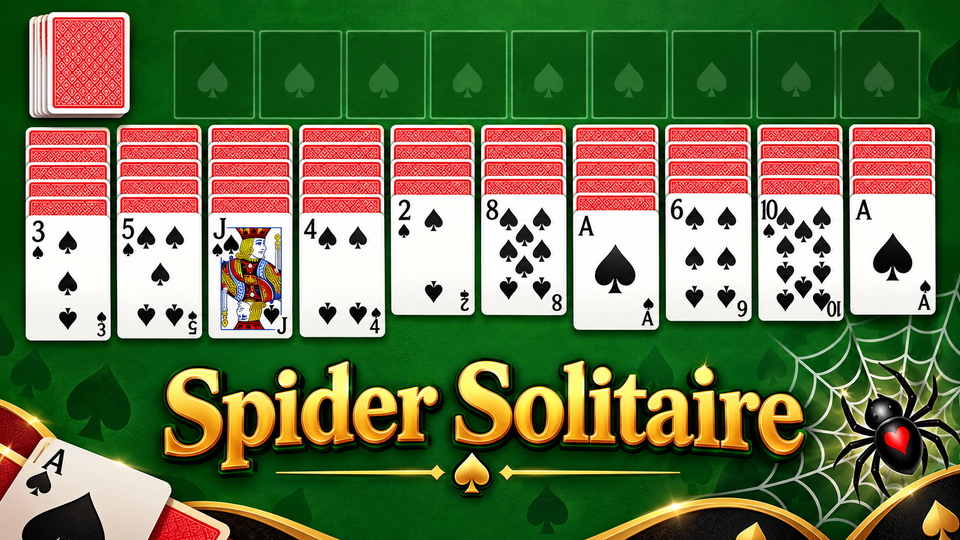
A Klondike game uses one standard deck of 52 cards. Twenty-eight cards form the tableau, which consists of seven columns. The first column contains one card, the second contains two, and the pattern continues until the seventh column contains seven cards. Only the top card of each column begins face up. The remaining 24 cards form the stock.
Four empty foundation spaces sit above the tableau. Each foundation eventually holds one complete suit in ascending order, beginning with the Ace and ending with the King.
Online versions are normally controlled with the mouse or equivalent touch interaction. Arkadium's browser version supports clicking face-down cards, clicking the stock, dragging cards between piles, and double-clicking certain cards to send them to a legal foundation.
The tableau is where most of the planning happens. Cards must descend by one rank while alternating between red and black. A red Queen can therefore be placed on a black King, while a black Jack can then be placed on that red Queen.
You can also move an ordered sequence together. If a column contains a black 9, red 8, black 7, and red 6 in valid descending order, that group can be transferred onto a suitable red 10.
The purpose of these moves is not simply to create long stacks. Moving cards should ideally reveal face-down cards or free a column that can later hold a King.
The four foundations are separated by suit. Each one starts with an Ace and then grows upward numerically: Ace, 2, 3, 4, and so on through Jack, Queen, and King. Once all four suits reach King, every card has been cleared from the tableau and stock.
Moving low cards such as Aces and 2s to the foundations usually opens useful space. Higher cards sometimes require more thought because you may still need them in the tableau to support a sequence and uncover another hidden card.
Cards that were not included in the initial tableau form the stock. Clicking the stock reveals cards that may be moved either to the tableau or directly onto the foundations when legal. Unused exposed cards are associated with the waste pile.
Many digital versions offer both Draw 1 and Draw 3. Draw 1 reveals one stock card at a time and is generally easier to manage. Draw 3 reveals cards in groups of three and makes accessing particular stock cards more restrictive.
Clearing an entire tableau column creates one of the most useful spaces in Solitaire. Under standard Klondike rules, only a King can be moved into an empty column.
That restriction makes the timing important. Clearing a column is most valuable when you have an accessible King that can use the space and help uncover additional cards elsewhere.
Do not move a King into an empty column merely because the move is legal. First check whether doing so actually frees another face-down card or improves the layout.
Moves that uncover face-down cards generally create more possibilities than moves that only rearrange already visible cards. When choosing between two legal actions, consider which one reveals new information.
Low foundation cards rarely provide much structural support in the tableau. Moving an available Ace or 2 upward can free space and allow cards beneath it to become accessible. Arkadium specifically recommends moving Aces and 2s to the foundations when possible.
Because only Kings can occupy empty tableau spaces, clearing a column without an available King may temporarily reduce the number of places where you can rearrange cards.
Using the stock adds more cards to consider, but it does not fix missed moves already available on the board. Before drawing again, inspect each exposed tableau card for foundation moves and alternating-color sequences.
A card that can legally move to a foundation may still be useful in the tableau. For example, a red 6 may be needed to hold a black 5 that currently blocks an important face-down card.
| Mode | How the Stock Works | Main Effect |
|---|---|---|
| Draw 1 | Reveal one stock card at a time. | More direct access to stock cards and simpler planning. |
| Draw 3 | Reveal three cards at a time. | Card order matters more because not every stock card is immediately accessible. |
Both modes use the same tableau and foundation objective. The difference is how cards from the stock become available.
If you enjoy organizing cards and solving single-player card layouts, try these related games on YaloGames:
In classic Klondike Solitaire, the objective is to move all 52 cards onto four foundations, separated by suit and built from Ace to King.
There are seven tableau columns. They begin with one through seven cards respectively, with only the top card in each pile initially face up.
No. Under standard Klondike rules, an empty tableau column can only be filled by a King or a movable sequence beginning with a King.
Draw 1 reveals one stock card at a time, while Draw 3 reveals cards in groups of three. Both use the same basic Klondike objective.
Solitaire is a broad category of single-player card games, but the game commonly called Classic Solitaire is generally Klondike. Arkadium, for example, uses identical gameplay for its Classic Solitaire and Klondike versions.
Solitaire rewards careful card management rather than simply making every legal move as soon as it appears. Focus on revealing hidden cards, build tableau sequences in alternating colors, create useful spaces for Kings, and use the stock only after checking the available moves on the board. Each card moved to the correct foundation brings the layout closer to the final goal of completing all four suits from Ace through King.
LIVE CHAT
No messages yet. Start the conversation.
Log in to join the chat.
Login