Loading game
Preparing player
Loading game
Ready to play
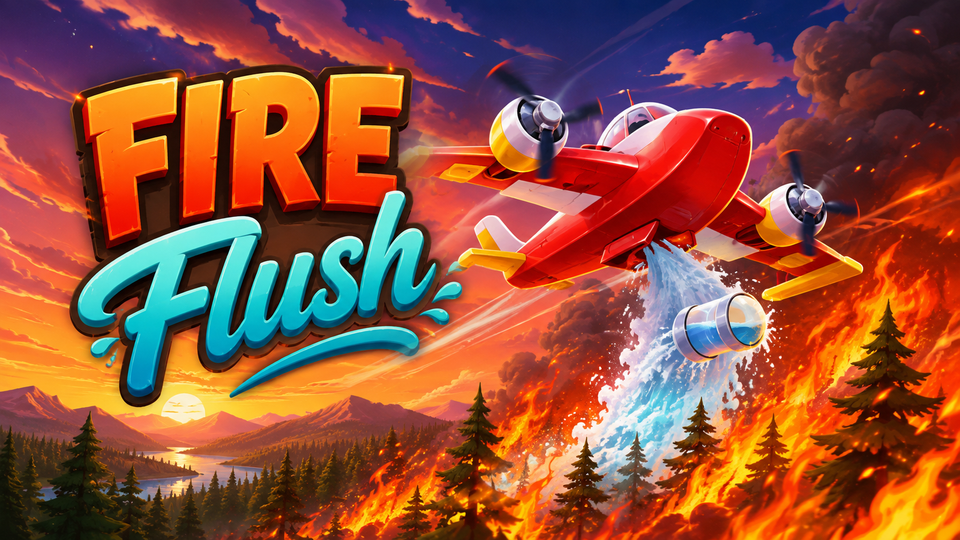
Play Fire Flush online for free. Fly with Scruffy, refill water from lakes, dodge cliffs and caves, extinguish wildfires, unlock planes, and earn three stars.
Fire Flush is a fast-paced aerial firefighting game where you join Scruffy, a courageous firefighting dog, and take to the skies to save burning forests. Pilot your aircraft through dangerous jungle terrain, skim across lakes to refill the water tank, fly between cliffs and caves, and release perfectly timed water drops over raging wildfires before they spread out of control.
The controls are simple, but successful rescue missions demand precise flying. You need to balance altitude, aircraft tilt, water capacity, speed, and positioning at the same time. Dive too aggressively toward a lake and you can crash. Fly too cautiously and valuable time disappears while the forest continues burning. The challenge is finding a smooth rhythm between refilling, climbing, navigating, and extinguishing fires.
Your main objective in Fire Flush is to extinguish every wildfire in the current mission without crashing your aircraft.
Begin by checking your available water supply and locating the fires around the level. If your tank needs water, guide the aircraft toward a nearby lake and carefully lower your flight path until you can refill.
Once the tank contains enough water, climb back into the sky and head toward the burning area. Avoid cliffs, trees, cave ceilings, terrain, and other dangerous obstacles along the route.
When you approach a fire, level the plane and press the water control at the correct moment. A well-timed drop lands directly on the flames and uses your limited supply efficiently.
If water runs out before every fire is extinguished, return to the lake, refill, and begin another firefighting pass.
The basic gameplay loop is:
Fire Flush uses only a small number of controls, but every movement affects your speed, angle, altitude, and ability to safely refill or extinguish fires.
Fire Flush turns firefighting into an unusual flying challenge.
Instead of controlling a fire truck from the ground, you need to approach dangerous wildfires from the air and manage a limited water supply while flying through hazardous terrain.
Every mission combines two skills:
Ignoring either side of the game creates problems. Excellent flying does not help if you repeatedly miss your water drops, while accurate drops are useless if your plane crashes before reaching the next fire.
Scruffy is the heroic pilot at the center of Fire Flush.
Instead of leaving the burning forest to its fate, the brave dog climbs into an aircraft and takes responsibility for extinguishing fires across dangerous environments.
The unusual canine hero helps give Fire Flush a lighthearted personality even when the missions become increasingly demanding.
Water is your most important resource during every rescue mission.
Your aircraft cannot carry an unlimited supply, so longer levels require repeated trips between the fire and nearby lakes.
Approach the water carefully and lower the aircraft enough for the refill system to activate.
Once the tank is full or contains enough water for your next attack, pull away smoothly and begin climbing before terrain becomes dangerous.
Refilling is one of the most skill-based parts of Fire Flush.
Flying too high above the lake may prevent your tank from filling efficiently. Diving too aggressively creates a much greater risk of hitting the water or nearby terrain at a dangerous angle.
The ideal approach keeps the aircraft low enough to collect water while maintaining enough forward momentum to safely climb away afterward.
When approaching a lake from above, do not suddenly point the aircraft straight toward the surface.
Begin lowering your altitude earlier and create a controlled descent.
This gives you enough time to adjust your tilt before reaching the water and makes the refill much more predictable.
A smooth dive also preserves momentum that can be useful when climbing toward the next wildfire.
One of the easiest mistakes is concentrating so heavily on filling the tank that you forget what comes immediately afterward.
As soon as enough water is collected, begin adjusting your plane toward a safer climbing angle.
Waiting too long can send the nose toward terrain, trees, or the opposite edge of the lake.
Always think about your exit path before beginning the refill.
A completely full tank is useful, but you may not always need maximum capacity for the remaining fire.
If only a small burning zone remains and your current water supply is nearly sufficient, a shorter refill may allow you to return faster.
Efficient missions are about carrying enough water for the task rather than automatically spending extra time filling every possible unit.
Once your tank contains water, identify the safest route toward the next burning area.
The fastest direct line is not always the safest path.
Cliffs, caves, narrow passages, and terrain can make another approach slightly longer but much easier to control.
Choose a route that allows you to arrive at the fire with a stable aircraft rather than one that forces a desperate last-second correction.
Water-drop accuracy improves when the aircraft is stable.
If you release water while turning sharply or diving aggressively, the payload may miss the intended burning area.
When possible, approach the fire on a relatively level trajectory and make your final adjustments before pressing Spacebar.
A clean approach provides more predictable water placement.
Dropping water too early wastes part of your limited supply before the aircraft reaches the target.
Dropping too late can send the water beyond the burning area.
Watch your horizontal position carefully and release when the plane is aligned with the fire below.
After several missions, you will begin developing a better sense of how far the water travels before reaching the ground.
Every missed drop creates another potential trip back to the lake.
That additional flight costs time and introduces more opportunities to crash.
Try to make every payload contribute toward extinguishing an active fire.
Accuracy therefore improves both safety and mission completion time.
When several burning zones are active, prioritize the areas creating the greatest problem.
A larger fire may require more water and additional passes, so beginning early prevents it from consuming too much of your remaining mission time.
Smaller isolated fires can sometimes be handled later with whatever water remains in the tank.
If two fires are positioned relatively close together, one tank may be enough to attack both before returning to the lake.
Plan your flight path so the first drop naturally leads toward the next target.
Efficient routing reduces unnecessary travel and can improve your mission rating.
Water needs to reach the fire, but your aircraft does not.
Approach from enough altitude to safely release your payload without colliding with dangerous terrain or the burning area itself.
Protecting the aircraft remains more important than creating the closest possible water drop.
Rock formations can create dangerous sections where one incorrect tilt immediately ends your flight.
Look ahead and begin adjusting your altitude before reaching the cliff.
Last-second movements are much harder to control because the plane needs time to respond to changes in direction.
Early preparation keeps your trajectory smoother.
Caves create some of the most precise flying challenges in Fire Flush.
You have limited vertical space and need to avoid both the floor and ceiling.
Enter low enough to clear the upper rock formation but remain as level as possible once inside.
Strong steering inputs can quickly turn a safe cave entry into a collision.
When flying through a tight section, small adjustments are much safer than dramatic tilts.
Avoid reacting to every tiny change in altitude with a full directional input.
Make controlled corrections and allow the aircraft enough time to respond before changing direction again.
Do not stare directly at Scruffy's aircraft.
Keep part of your attention farther ahead so you can identify the next lake, cliff, cave entrance, or fire before reaching it.
The earlier you see the next challenge, the easier it becomes to create a safe trajectory.
Tilt affects much more than visual orientation.
It determines whether your plane climbs, descends, lines up with water, or approaches the next obstacle safely.
Large tilt changes are useful when you deliberately need a strong dive or climb, but most normal flight should use smaller corrections.
Rapidly switching between opposite directions can make the aircraft unstable.
Make one adjustment and observe how the plane responds before immediately correcting again.
Smooth flying gives you better control over both water refills and firefighting passes.
Momentum helps you travel efficiently between lakes and burning areas.
Avoid unnecessary climbs and dives that constantly remove speed from your flight path.
Use terrain strategically and try to create smooth transitions between descending toward water and climbing toward the next target.
Fast flights improve mission time but increase the difficulty of every correction.
Slow flying provides more reaction time but may make three-star performance harder.
The ideal strategy is controlled speed: travel quickly through open areas and become more cautious around caves, cliffs, lakes, and tight fire zones.
Fire Flush missions use a star-based performance system in documented browser versions.
Completing the mission successfully is only the first goal. Stronger performance can earn additional stars and contribute toward progression.
Better ratings generally encourage:
Replay earlier missions once your flying skill improves and try to convert basic completions into three-star results.
Your first completion teaches you the level layout.
During later attempts, you already know where the water sources, fires, caves, and dangerous terrain are located.
Use that knowledge to create a more efficient route and improve your performance rating.
Some documented Fire Flush versions unlock a Survival Mode after collecting 12 stars.
Instead of completing one normal mission, Survival creates a longer test of your ability to keep controlling fires while maintaining the aircraft.
Before entering, practice consistent refills and accurate water drops because small mistakes become more expensive during an extended challenge.
Normal missions teach the skills required for the endless challenge.
Before focusing on Survival, become comfortable with:
Consistency matters more than one spectacular maneuver.
Progression gives you access to a varied collection of aircraft.
Current browser listings document up to 16 unlockable planes in some versions, ranging from conventional jets to deliberately ridiculous vehicles such as a flying avocado.
New aircraft provide additional reasons to earn stars, collect rewards, and replay missions.
Not every aircraft handles identically.
Some can emphasize speed, while others may offer different maneuverability, refill performance, or water capacity depending on the version.
Test newly unlocked aircraft rather than automatically staying with the starting plane forever.
A vehicle that matches your flying style can make difficult missions much easier.
Fast aircraft can reduce travel time between the lake and fire.
Their additional speed is particularly useful on open levels where long distances separate objectives.
However, higher speed means less reaction time around cliffs and caves.
Choose fast aircraft when you are already comfortable with the current mission layout.
One of Fire Flush's most unusual unlockables is an avocado-shaped aircraft.
The strange vehicle reflects the game's playful tone and gives you another reason to experiment with the aircraft roster.
Do not assume unusual-looking vehicles are purely cosmetic. Different documented versions give aircraft varying flight characteristics.
Extra water capacity can reduce how frequently you need to return to a lake.
This becomes particularly valuable when several fires are positioned far from the nearest refill source.
A larger tank lets you attack more burning zones during one trip and can improve overall mission efficiency.
Speed-related power-ups help reduce travel time between distant objectives.
Use additional speed in open sections where you have enough room to safely handle the faster aircraft.
Avoid becoming overly aggressive immediately before a cave or tight cliff section.
Some Fire Flush builds include defensive equipment such as fire-resistant gear or crash protection.
These bonuses provide additional forgiveness during difficult missions.
They are particularly useful when a route forces you to fly close to dangerous burning areas or tight terrain.
Protection should supplement careful flying rather than encourage unnecessary crashes.
An additional tank provides maximum value when the mission contains several fires located close together.
Instead of returning after every drop, complete multiple attack passes during one refill cycle.
Plan the order of your targets before leaving the water source.
Different missions create different problems.
If travel distance is the main challenge, speed can provide the largest benefit.
If repeated water trips are slowing you down, additional tank capacity may help more.
If dangerous terrain causes frequent failures, protective equipment can offer additional security.
Choose the tool that solves your actual problem.
Begin descending early instead of diving directly toward the water at the final moment.
Prepare your exit before the tank is completely filled so you do not crash into terrain.
A stable horizontal pass makes your payload much easier to aim.
Identify caves, cliffs, lakes, and fires before they become immediate threats.
Smooth input creates more predictable aircraft movement than constant aggressive tilting.
If several fires are nearby, attack them during one trip whenever your water capacity allows.
Additional speed is easiest to manage when cliffs and caves are not immediately ahead.
Experiment with unlocked planes and choose one whose handling suits the current mission.
Learning the map first makes efficient high-rating attempts much easier.
One slightly slower flight is better than crashing and restarting the entire mission.
The best refill starts before your aircraft reaches the lake.
Create a controlled descending trajectory early enough that the plane approaches the water with useful forward speed.
Skim through the refill zone and watch your tank increase.
As soon as enough water is available, begin tilting toward a climb.
With practice, the entire sequence becomes one continuous motion rather than a dive followed by an emergency recovery.
Accuracy depends on both positioning and aircraft stability.
Approach the wildfire from a predictable direction and level your plane before reaching the target.
Watch how quickly you are moving and release early enough for the water to fall onto the flames rather than behind them.
Remember the result and slightly adjust your timing during the next pass if necessary.
Most crashes happen because the player reacts too late or uses an extreme correction.
Look farther ahead and begin adjusting your route before cliffs, cave walls, and water surfaces become immediate dangers.
Use gradual changes whenever the situation allows them.
Inside narrow areas, maintain a relatively stable plane instead of rapidly switching directions.
Enter the cave on a level trajectory rather than arriving while climbing or diving aggressively.
Stay low enough to clear the ceiling but leave enough space above the ground.
Make only small altitude corrections inside.
Once the exit becomes visible, begin preparing for whatever terrain or objective comes next.
First complete the mission normally and learn where every important objective is located.
During the next attempt, reduce unnecessary flying between fires and lakes.
Improve your water-drop accuracy so fewer refills are required and maintain enough speed through open sections.
Avoid crashes and inefficient detours.
A clean route with accurate firefighting is more reliable than reckless maximum-speed flying.
Plan your route before leaving the lake.
If several fires exist, decide which one should be attacked first and whether the remaining water can reach another target afterward.
Approach each fire from a stable direction and avoid wasting water outside the burning area.
Efficient targeting reduces both the number of drops and the number of refill trips.
Match every power-up with the part of the mission where it creates the most value.
Use speed bonuses during long open flights, extra tank capacity when multiple fires need water, and defensive bonuses in areas with dangerous terrain or flames.
Avoid activating a useful temporary bonus when you are already close to completing the mission without it.
Continue completing missions, collecting rewards, and improving your star ratings.
Some aircraft are tied to progression milestones or accumulated rewards depending on the version.
Replaying earlier stages for additional stars can therefore help unlock more vehicles while simultaneously improving your flying skill.
Identify what specifically causes the failure.
If you repeatedly crash during refills, practice your lake approach separately.
If you run out of water, work on drop accuracy or choose an aircraft with more useful capacity.
If caves are the problem, reduce aggressive steering and enter them more level.
If your completion time is too slow, optimize your route only after you can finish reliably.
Water is a limited resource, making precision more important than rapid button pressing.
One accurate drop can save an entire refill trip.
Wait until the aircraft is properly aligned instead of releasing simply because the fire appears somewhere below you.
Fire Flush feels fast, but flying at maximum speed throughout the entire level is not always the best strategy.
Open areas reward speed, while caves, lake approaches, and difficult fire zones reward control.
Learning when to slow your movements and when to push forward aggressively is one of the main steps toward mastering the game.
The water tank gives Fire Flush more depth than a normal flying obstacle game.
Every payload reduces the amount available for the next fire.
Every refill takes time and requires another dangerous approach toward the lake.
The strongest pilots therefore plan both their flight and their water usage.
Fire Flush uses only movement keys and one firefighting action, but those few controls interact with the aircraft physics in many different ways.
The same tilt that helps you dive into a lake can become dangerous inside a cave.
The speed that helps you earn a better mission time can make your next water drop harder to aim.
That balance keeps the controls accessible while providing room for improvement.
Fire Flush combines arcade flying, aerial firefighting, physics-based movement, water management, precision bombing, obstacle avoidance, unlockable aircraft, power-ups, mission ratings, and a charming animal hero into an unusual browser game.
The basic objective is immediately understandable: collect water and extinguish the forest fires.
The deeper challenge comes from performing every part of that mission efficiently. You need to control your aircraft through narrow terrain, refill without crashing, preserve momentum, aim your water accurately, and decide when another lake trip is necessary.
Three-star ratings give you a reason to replay missions after completing them, while unlockable aircraft and Survival Mode provide additional long-term goals.
Whether you enjoy airplane games, rescue missions, arcade challenges, precision flying, or games where simple controls reward practice, Fire Flush offers a distinctive combination of speed and strategy.
Take off with Scruffy in Fire Flush and begin your mission to save the burning forest. Guide your aircraft through colorful jungle environments, dive carefully toward lakes, refill your water tank, and climb back into the sky before the terrain catches you.
Navigate dangerous cliffs and caves, line up your approach, release water directly over the flames, and continue flying until every wildfire has been extinguished.
Earn three-star ratings, unlock new aircraft, experiment with power-ups, master increasingly difficult missions, and prove that Scruffy can become the ultimate airborne firefighter.
If you enjoy Fire Flush, try these similar flying, rescue, physics, reflex, and arcade games on YaloGames:
LIVE CHAT
No messages yet. Start the conversation.
Log in to join the chat.
Login