Loading game
Preparing player
Loading game
Ready to play
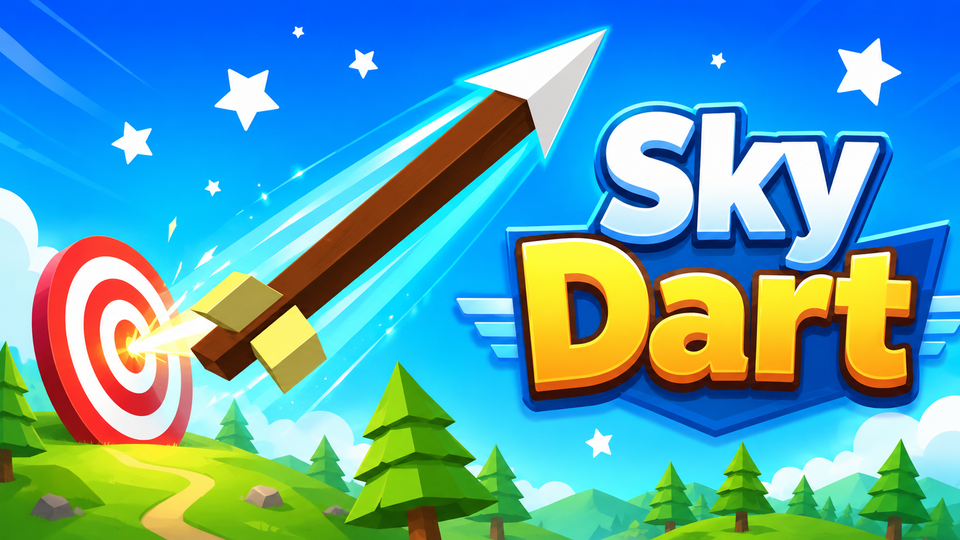
Play Sky Dart online for free. Aim and launch your arrow, steer through obstacles, hit targets and bullseyes, collect coins, upgrade power, and fly farther.
Sky Dart is a physics-based archery and flying game where one carefully aimed shot becomes a long-distance journey through the sky. Choose your launch angle, charge the correct amount of power, release your arrow, steer around obstacles while airborne, fly through useful boost rings, hit targets for bonus rewards, and keep traveling until your momentum finally disappears.
The controls are easy to learn, but achieving a long distance requires much more than simply using maximum power. Your launch angle determines the opening trajectory, smooth mid-air movement helps preserve momentum, obstacles can immediately interrupt a strong run, and valuable target boards tempt you to change course for additional coins.
Your main objective in Sky Dart is to launch your arrow as far as possible and continuously improve your distance record.
Before shooting, move the mouse to choose your angle. Then hold the left mouse button to build launch power.
Release when you are satisfied with the combination of direction and strength. The arrow launches forward and begins traveling across the environment.
The challenge does not end after the shot. You can continue making small mid-air adjustments to guide your arrow around obstacles, toward bonus targets, and through useful boost rings.
When the flight ends, your distance and performance provide coins that can be invested into upgrades. Improve your arrow and return for another attempt.
The basic gameplay loop is:
Sky Dart uses a minimal control scheme, so most of the challenge comes from understanding trajectory, momentum, steering, and timing.
Your opening angle determines the foundation of the entire flight.
A very low trajectory may create strong horizontal movement but leave little height for clearing obstacles. A very high shot can provide more airtime but may sacrifice useful forward distance.
Try beginning with a balanced angle that gives your arrow both altitude and horizontal momentum.
As targets move farther away, gradually adjust your launch angle instead of making extreme changes after one failed attempt.
More power does not automatically mean a better shot.
Maximum charge can send your arrow farther initially, but excessive speed can also make obstacles and targets more difficult to react to.
Medium-to-high power is often useful while learning because it gives you enough distance without removing all control.
Once you understand the route and steering response, begin experimenting with stronger launches.
One common beginner mistake is fully charging every shot.
A maximum-power launch can be useful on open routes, but it may create a poor trajectory when several obstacles appear early in the flight.
Instead, think about the environment ahead.
Use enough power to establish strong momentum while preserving the control needed to navigate the route.
Sky Dart differs from traditional archery games because your influence does not end when the arrow leaves the bow.
You can make small adjustments during flight to change your path.
Use this control to:
Mid-air steering becomes increasingly important as your arrow begins reaching more complicated areas.
Sharp movements can cost valuable momentum.
Instead of dragging aggressively from one side to another, guide the arrow with small corrections whenever possible.
Smooth movement lets you avoid obstacles without dramatically disrupting the direction and speed of your flight.
If your arrow is already traveling along a safe path, avoid unnecessary steering.
Your arrow gradually loses speed as the flight continues.
Every unnecessary movement can make that slowdown worse, so efficient control matters.
A good run is not simply about launching quickly. It is about preserving useful forward movement for as long as possible.
Avoid dramatic trajectory changes unless they help you reach a valuable boost or prevent a collision.
Trees, buildings, rocks, barriers, and other environmental objects can interrupt your flight.
Look farther ahead rather than concentrating only on the arrow itself.
When you see a hazard, begin making a small correction early.
Waiting until the obstacle fills the screen usually forces a much sharper movement that reduces momentum or causes a crash.
Long-distance flights require anticipation.
Keep your attention focused beyond the immediate position of the arrow so you can identify the next target, obstacle, or boost ring in advance.
The earlier you recognize a useful route, the smaller your steering correction can be.
This becomes increasingly valuable as your speed and travel distance improve.
Boost rings can help extend your flight by restoring or improving your momentum.
When one appears close to your current route, guide the arrow toward it using smooth movements.
A successful boost can add significant distance, especially when your arrow is beginning to slow down.
However, do not sacrifice a stable run for a ring that requires an extreme change of direction.
Boosts become especially valuable later in a flight when natural momentum begins fading.
A ring reached while already traveling at excellent speed still helps, but one reached near the point where your arrow would otherwise begin falling can completely revive the run.
Whenever several routes appear possible, consider which one provides the strongest combination of safety and boost opportunities.
Target boards provide bonus rewards during your flight.
Steering into one can increase the amount of coins earned from the run.
A normal target hit can provide a strong reward multiplier, giving accurate players another reason to take carefully calculated routes instead of simply flying straight ahead.
Targets turn each run into a constant risk-and-reward decision between maximum distance and additional currency.
The center of a target provides an even better reward than an ordinary hit.
A bullseye can significantly multiply the coins earned from the target.
When your arrow is already aligned well, make small corrections and try to pass through the center rather than simply touching the outer edge.
Do not aggressively chase a bullseye from a poor angle, however. Losing the entire flight may cost more than the bonus is worth.
Flying farther generates more opportunities to earn currency, while targets provide additional reward multipliers.
The best route is therefore not always the most direct route or the route containing the largest number of targets.
Choose targets that can be reached without dramatically reducing your momentum.
As your control improves, you will become better at combining long-distance flights with accurate bonus hits.
Distance converts your performance into progression currency.
Even a run that fails to beat your personal record can still provide enough coins for another improvement.
This creates a useful progression cycle:
Every attempt can therefore contribute toward making future flights better.
Power upgrades improve how effectively your arrow can begin and maintain a long-distance flight.
A stronger launch allows you to reach farther areas and gives you more opportunities to encounter targets, boost rings, and new zones.
If your flights consistently end before reaching the next progression milestone despite good control, additional power may provide the improvement you need.
Control or stability upgrades make mid-air steering easier and more effective.
These improvements are particularly valuable if you regularly lose strong runs while trying to avoid obstacles or line up with targets.
Raw power gives you more potential distance, but better control helps you actually use that potential.
Players who struggle with unpredictable movement should consider improving control instead of investing exclusively in speed.
Earnings upgrades improve how quickly your economy develops.
Greater rewards allow you to purchase additional power and control improvements sooner.
This creates a compounding effect where stronger earnings lead toward stronger performance upgrades, which then allow longer flights and even better rewards.
Balancing performance and economy can make long-term progression significantly faster.
Putting every coin into one statistic can create weaknesses elsewhere.
A high-powered arrow with poor control may reach hazards faster without giving you enough precision to avoid them.
Excellent control with very weak power can make navigation easy but limit how far your arrow can reach.
Upgrade according to whichever weakness is currently ending your runs.
Power is a strong early choice because it immediately improves your potential distance.
Once your arrow begins reaching faster and more complicated sections, control becomes increasingly important.
Earnings upgrades are useful when progression costs start increasing and you want each successful flight to contribute more currency.
There is no single perfect order. Watch how your runs end and improve the statistic most responsible for the limitation.
Longer flights allow you to progress beyond the earliest areas.
New zones provide a visible reason to improve your distance instead of simply increasing one number forever.
As you travel farther, expect navigation to become increasingly demanding.
Better upgrades help, but accurate launch timing and controlled steering remain essential.
Your first attempts should be treated as calibration.
Experiment with different launch angles and charge levels to understand how the arrow responds.
Watch how quickly it loses height and how sharply mid-air steering changes the flight path.
Once you understand these basics, later long-distance attempts become much more predictable.
Repeated shots help you develop a sense for trajectory.
Notice how high the arrow climbs after different launch angles and how quickly it begins descending.
This knowledge helps you determine whether you need to aim above a distant target or use more launch power.
Eventually, you can begin predicting the route before the arrow even leaves the starting point.
If a shot performs poorly, avoid changing both angle and power dramatically on the next attempt.
Change one factor slightly and observe the result.
If the arrow falls short, increase power or adjust the angle upward. If it travels too high without enough forward distance, use a flatter trajectory.
Small controlled experiments make it easier to understand what actually improves your flight.
One of the easiest ways to waste momentum is constantly changing direction.
Every sharp adjustment can make the arrow less stable and reduce useful forward speed.
Only steer when an obstacle, target, or boost gives you a clear reason.
A mostly straight and controlled flight can often travel farther than an aggressive route full of unnecessary corrections.
During early progression, prioritize targets that sit close to your natural path.
These provide bonus coins without requiring dangerous steering.
Once your control upgrades and experience improve, begin attempting harder bullseyes and targets positioned farther from the main route.
When your arrow is already traveling farther than your previous personal best, consider whether another risky target is really worth chasing.
Sometimes maintaining a stable flight provides more overall value than attempting one bonus and crashing immediately.
The better you become at reading trajectories, the easier it becomes to recognize when a target is genuinely safe.
Avoid extremely high or low launches while learning. A balanced trajectory gives you more flexibility.
Maximum power is useful only when you can control the resulting speed and trajectory.
Small mid-air corrections preserve momentum better than aggressive movements.
Spot obstacles and boost rings early so you can prepare your route gradually.
A well-positioned boost can significantly extend a flight that is beginning to slow.
Bonus coins are useful, but avoid dangerous detours that end your run prematurely.
If the arrow is already approaching a target cleanly, refine your trajectory toward the center for a better reward.
Additional power provides little value if you constantly crash before using the extra distance.
Remember whether your angle, power, or steering caused the problem and adjust only what needs improvement.
Several controlled long flights usually provide faster progression than repeatedly attempting extreme launches that fail early.
Long-distance flights require launch quality, momentum management, and useful upgrades working together.
Begin with a balanced trajectory and enough power to establish strong forward speed.
Once airborne, avoid unnecessary steering. Make small corrections around obstacles and line up with boost rings whenever they can be reached efficiently.
Use your coins to improve power and control as your current distance begins plateauing.
The combination of better equipment and cleaner movement will gradually push your record farther.
Do not wait until a target is directly beside your arrow before trying to line up.
Identify the target early and begin shifting toward it gradually.
Try to intersect the target while maintaining approximately the same overall direction of travel.
If hitting the board requires a complete reversal or extreme turn, skipping it may be more efficient.
Bullseyes require finer control than ordinary target hits.
Approach the board with as stable a trajectory as possible and avoid large corrections during the final moment.
Use small mouse or swipe movements to line up with the center.
Practice on easier targets before deliberately sacrificing distance to chase difficult bullseye rewards.
Obstacle avoidance depends on seeing danger early.
Keep your focus ahead of the arrow and begin adjusting before a tree, structure, or barrier becomes an immediate threat.
Whenever possible, move around the edge of an obstacle rather than making a dramatic climb or dive.
The smoother your avoidance path, the less momentum you lose.
Boost rings provide the most value when they fit naturally into your flight path.
Begin lining up early and avoid rushing toward the ring with sharp movements.
After receiving the boost, stabilize your trajectory instead of immediately making another major turn.
Preserving the additional momentum is just as important as obtaining it.
The best coin strategy combines distance with accurate target hits.
Long flights provide stronger base rewards, while target and bullseye bonuses can multiply the value of a successful attempt.
Do not chase bonuses so aggressively that your average distance becomes much shorter.
First build consistent long flights, then begin incorporating more target hits into those runs.
If your record stops improving, identify the exact reason.
If the arrow simply loses momentum before reaching the next section, improve Power.
If obstacles regularly destroy otherwise strong flights, upgrade Control and focus on smoother steering.
If upgrades are taking too long to afford, improve Earnings or concentrate on safe targets and bullseyes.
Fixing the correct limitation is more effective than purchasing upgrades randomly.
Sky Dart may appear like a simple casual game, but random inputs quickly reduce your performance.
Every movement influences the arrow's trajectory and momentum.
A player who makes only a few precise corrections can often travel much farther than someone constantly dragging the arrow around the screen.
Good control means knowing when not to move as much as knowing when to steer.
Sky Dart uses only aiming, charging, releasing, and basic flight control.
There are no complicated combat combinations or large control schemes to memorize.
The difficulty comes from combining those simple inputs accurately across increasingly long flights.
New players can understand the game almost immediately, while experienced players can continue refining launch angles, boost routes, bullseyes, and momentum management.
Sky Dart combines archery, physics-based flight, distance challenges, mid-air steering, target shooting, boost rings, upgrades, and high-score progression into an accessible browser arcade game.
The objective is immediately understandable: launch your arrow and make it fly farther.
The deeper challenge comes from balancing angle, power, momentum, and precision. You need to avoid obstacles without oversteering, decide whether bonus targets are worth the risk, and use boost rings to extend promising flights.
Coins make every run useful because even an attempt that fails to break your record can contribute toward stronger upgrades.
Whether you enjoy archery, precision games, physics challenges, distance records, or simple games that reward repeated practice, Sky Dart provides a quick gameplay loop with plenty of room for improvement.
Take aim in Sky Dart and see how far one arrow can travel. Adjust your launch angle, charge the shot, release at the right moment, and begin guiding your arrow across the open sky.
Avoid trees and obstacles, pass through boost rings, hit targets for bonus coins, chase bullseyes, upgrade your power and control, and continue pushing toward increasingly distant zones.
Refine every shot, preserve your momentum, and see how far you can fly in Sky Dart.
If you enjoy Sky Dart, try these similar archery, physics, launching, precision, and skill games on YaloGames:
LIVE CHAT
No messages yet. Start the conversation.
Log in to join the chat.
Login