Loading game
Preparing player
Loading game
Ready to play
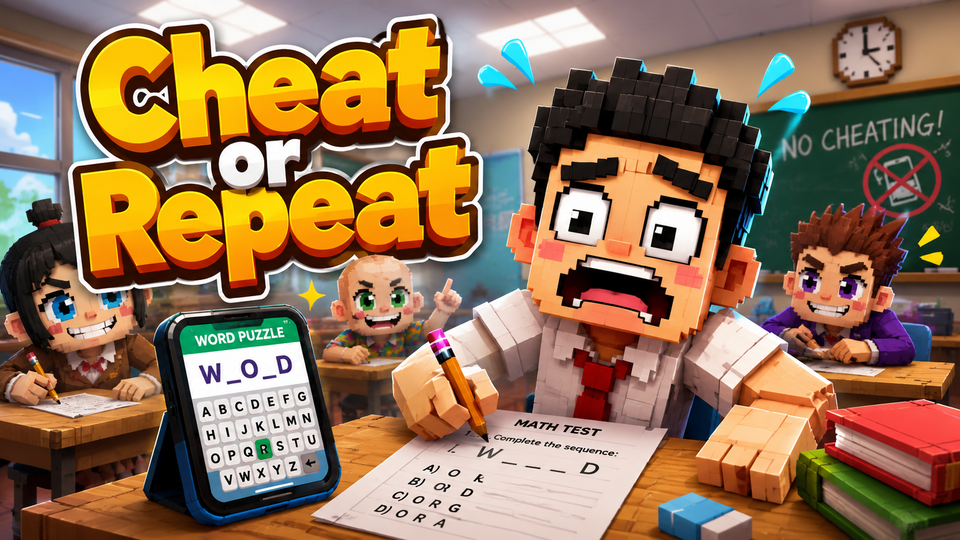
Play Cheat or Repeat online for free. Secretly use your phone, watch the teacher, find exam answers, avoid suspicion, and survive every test day.
Cheat or Repeat is a tense classroom stealth and puzzle game where an ordinary school exam becomes a nerve-racking survival challenge. You arrive completely unprepared, sit down in front of your test paper, and quickly realize that passing will require more than guessing. Secretly check your phone for answers, monitor the teacher, complete search inputs, choose the correct responses, and hide everything before anyone notices what you are doing.
The concept sounds simple, but every action carries risk. Looking at your phone for too long can expose you, concentrating completely on the search can make you forget about the teacher, and panic can cause you to press the wrong answer. Success depends on observation, timing, memory, and staying calm while the classroom becomes increasingly stressful.
Your main objective in Cheat or Repeat is to complete the exam without being caught using your phone.
Begin by checking the question on your exam sheet. If you do not know the answer, wait for a safe opportunity and secretly open your phone.
The phone gives you a sequence of inputs that must be entered to search for the correct answer. Complete the search quickly, remember the result, hide the phone, and return your attention to the test paper.
Use the number keys to choose the correct answer and continue to the next question.
While doing all of this, regularly look around the classroom and track where the teacher is moving. If the teacher approaches while your phone is visible, immediately hide it and return to normal exam behavior.
The basic gameplay loop is:
The controls are simple, but you constantly switch between them under pressure. The challenge is performing the correct action without losing awareness of what is happening around you.
Your test paper is the center of the entire challenge.
Before taking any risk, understand which question you are trying to answer. There is little value in opening your phone if you do not know what information you need.
Keep your normal exam view as the safest default position. Whenever the teacher becomes suspicious or approaches your desk, returning to the paper makes your behavior appear much less unusual.
Think of the exam sheet as your safe state and the phone as your risky state.
Your phone is the key to finding answers, but it is also the easiest way to get caught.
Press Spacebar when you believe the teacher is safely away from your desk. Complete the required search sequence as efficiently as possible and avoid leaving the phone visible longer than necessary.
Once you obtain the answer, memorize it and immediately return to the exam.
Do not continue staring at the phone simply because the teacher currently appears far away. Their position can change quickly.
Teacher movement determines when cheating is safe.
Use the right mouse button to check your surroundings before opening the phone.
Instead of thinking only about where the teacher is now, consider where they are moving next.
A teacher walking away from your desk provides a better opportunity than one standing far away but moving directly toward you.
Learning these movement patterns is one of the most important skills in Cheat or Repeat.
Teachers do not remain completely stationary during the exam.
Watch how they move through the classroom and notice when longer safe windows appear.
After several attempts, you may recognize moments where the teacher usually turns away or checks another part of the room.
Use those opportunities for longer phone searches and avoid risky actions when the patrol path brings the teacher close to you.
Long phone sessions are dangerous.
Even if the teacher begins far from your desk, they can approach while you remain focused on completing the search.
Develop the habit of opening the phone, completing only what is necessary, and returning to the paper immediately.
Short controlled cheating windows are usually much safer than trying to finish everything in one long sequence.
Visual awareness is important, but sound can also warn you that something around the classroom has changed.
If you hear an unusual signal while using your phone, stop concentrating entirely on the search and check whether the teacher is approaching.
Reacting quickly to audio warnings can save a run when you do not have enough time to manually look around first.
Playing with game audio enabled can therefore make classroom awareness easier.
Cheat or Repeat constantly asks you to switch between different sources of information.
You need the test paper to know the question, the phone to discover the answer, and the classroom view to understand whether cheating is currently safe.
Becoming faster at switching between these views reduces how long you remain vulnerable.
Eventually, the process should become almost automatic:
The phone search system requires you to respond to the indicators shown on screen.
Use the relevant W, A, S, D, Q, and E keys accurately rather than pressing them randomly.
Speed matters because every extra second spent searching increases the amount of time your phone remains exposed.
However, accuracy still matters more than pure button speed. A wrong key wastes additional time and increases your risk.
Once the phone reveals the correct response, remember it before returning to the test paper.
You do not want to reopen the phone simply because you forgot whether the correct choice was B or C.
Mentally repeat the answer before hiding the device.
Reducing unnecessary phone checks dramatically lowers the amount of exposure during each question.
After finding the answer, return to the exam sheet and use keys 1 through 4 to select the corresponding option.
Avoid pressing a number while you are still mentally switching between the phone and the test.
One rushed input can turn a successful cheating sequence into a wrong answer.
Pause for a brief moment, remember the option you found, and then submit it deliberately.
Panic is one of the biggest enemies in Cheat or Repeat.
When the teacher suddenly appears nearby, players often start pressing several controls at once.
That can lead to accidental phone usage, missed inputs, incorrect answers, or staying in the wrong view.
Use one clear priority: if danger appears, hide the phone first.
Once you are safe again, continue the exam normally.
Phone searches demand concentration, which makes it easy to forget the classroom around you.
This is especially dangerous during longer input sequences.
Develop the habit of regularly checking your surroundings instead of staring at the phone until the search is finished.
Good players divide their attention between making progress and monitoring danger.
You do not always need a huge period of safety.
Sometimes a short window is enough to complete part of a search before returning to the paper.
Breaking one risky action into several smaller actions can reduce the chance of being caught.
The exact strategy depends on how quickly the teacher is moving and how much search input remains.
If you suspect danger while the phone is visible, your first priority should usually be returning to a normal exam state.
Do not spend too much time looking around while continuing to display obvious cheating behavior.
Hide the device, then confirm where the teacher is.
Once the danger has passed, continue the search.
The classroom is more than a background environment.
Teacher positions, movement direction, warning sounds, classmates, and sightlines all provide information about whether your next action is safe.
Pay attention to these signals before deciding to open the phone.
Cheat or Repeat rewards players who observe first and act second.
The exam creates time pressure, but that does not mean every answer should be handled at maximum speed.
Waiting a moment for the teacher to move away can be safer than immediately pulling out the phone while they are nearby.
A few seconds of patience can prevent an entire run from ending.
Balance exam progress with detection risk instead of optimizing only for speed.
Every time you open your phone, you are making a risk-versus-reward decision.
The reward is progress toward another correct answer.
The risk is exposing yourself to the teacher.
The best players do not cheat constantly. They wait for moments where the probability of getting caught is relatively low.
This makes patience a genuine gameplay skill.
As you progress, classroom pressure increases.
Teachers can become more alert, safe windows become shorter, and you have less room for hesitation.
Strategies that work comfortably during the early exam sessions may become too slow later.
Improve your ability to read questions, complete searches, memorize answers, and hide the phone efficiently before advancing.
Do not assume every authority figure behaves exactly the same way.
Different exam sessions can change patrol pressure and how safe certain moments feel.
Spend part of each new section learning the teacher's behavior before becoming extremely aggressive with your phone usage.
Observation during the first few questions can prevent repeated failures later.
Harder stages punish slow reactions more severely.
A teacher who gave you several seconds to react earlier may later provide only a brief warning.
This makes efficient controls increasingly important.
Reduce unnecessary movement between views and learn exactly which input you need before touching another key.
Memory plays a larger role than it initially appears.
Remembering the phone answer means you do not need another risky check.
Remembering teacher patterns helps you predict safe windows.
Remembering the control sequence makes your search inputs faster.
Every piece of information you retain reduces the amount of time you need to expose yourself.
Before opening your phone, confirm that the teacher is not already moving toward you.
Search quickly and hide the phone immediately after finding the answer.
Do not repeatedly reopen the phone because you forgot which option was correct.
Warning sounds can help you recognize danger before the teacher enters your direct view.
When danger appears, hide the phone first and then reassess the classroom.
Repeated attempts help reveal which moments provide longer cheating opportunities.
Incorrect inputs waste valuable seconds and keep your phone exposed longer.
Your exam view is generally the safest place to be when the teacher is nearby.
Do not become so focused on typing that you forget to check your surroundings.
Several short safe phone checks can be better than one long risky attempt.
Avoiding detection begins before you open the phone.
Use the classroom view and determine whether the teacher is moving away from your desk.
When a safe opportunity appears, open the phone and complete the search efficiently.
Listen for warning signals and avoid staying focused on one screen for too long.
If the situation suddenly becomes dangerous, hide your phone immediately and return to the test paper.
The goal is not to cheat as often as possible. It is to cheat only when the risk is manageable.
Think of your phone as a temporary tool rather than another permanent screen.
Before opening it, know which question you are solving.
Once the phone appears, concentrate on completing the required search sequence without unnecessary hesitation.
Memorize the resulting answer, close the phone, and submit the option from your exam sheet.
Efficient phone usage minimizes the total amount of time you spend vulnerable.
Do not simply check whether the teacher is visible.
Look at movement direction as well.
A teacher who is currently distant but approaching may be more dangerous than one who is closer but walking away.
After several rounds, you can begin predicting when the next safe interval is likely to appear.
Use those predictable windows for your longest searches.
Keep your fingers prepared over the required keyboard region before opening the phone.
Read each indicator carefully and press the corresponding input without unnecessary movement.
Avoid guessing because correcting mistakes costs more time than performing the sequence carefully once.
With practice, the W, A, S, D, Q, and E inputs become much faster and more automatic.
Later exam sessions reward efficiency.
Reduce the amount of time between checking the question and starting the search.
Become more selective about when you open the phone and respond immediately when warning sounds or teacher movement suggest danger.
Instead of trying to become more reckless, become faster at performing the same safe sequence.
Better execution is more reliable than taking larger risks.
When you notice the teacher approaching, stop thinking about the answer for a moment.
Your immediate priority is avoiding detection.
Hide the phone, return to the paper, and wait until the danger passes.
Once the classroom becomes safe again, remember where you were in the search and continue.
Trying to finish one final input before hiding the phone is exactly the type of unnecessary risk that can end a successful run.
Always check whether the teacher is nearby before beginning a search.
Once you know the correct option, hide the device immediately.
Memorize the letter or number before returning to the exam sheet.
Audio cues may give you valuable time to react before the teacher reaches your desk.
Random keyboard inputs can slow down your search and increase the likelihood of mistakes.
Observation is important, but you still need to complete the exam. Use quick checks rather than spending the entire session looking around.
If one approach repeatedly gets you caught, change your timing instead of expecting a different result from the same behavior.
Cheat or Repeat creates time pressure, but pure speed does not guarantee success.
A player who searches extremely quickly but constantly gets caught will make less progress than someone who chooses safe opportunities.
The strongest approach combines speed with stealth.
Complete actions quickly once you decide to take them, but remain patient when the classroom is unsafe.
There are no weapons or complicated escape mechanics in Cheat or Repeat.
Your most important defensive tool is awareness.
Knowing where the teacher is gives you the information needed to decide whether opening your phone is reasonable.
Ignoring that information turns every question into a gamble.
Cheat or Repeat does not require a large control scheme.
You only switch views, use your phone, complete search inputs, and select answers.
The difficulty comes from doing those simple things while another character is constantly trying to catch you.
That pressure transforms ordinary keyboard inputs into tense decisions.
The game takes a familiar situation—sitting through an exam—and exaggerates the anxiety surrounding it.
A teacher walking between desks suddenly feels threatening because one badly timed phone check can ruin the entire attempt.
The classroom does not need traditional monsters to create tension.
Uncertainty, surveillance, time pressure, and fear of being caught provide the horror atmosphere.
Cheat or Repeat combines classroom simulation, stealth, puzzle mechanics, light horror, reaction-based gameplay, memory, and time pressure into a simple but unusual browser game.
The objective is immediately understandable: finish the test without being caught cheating.
The deeper challenge comes from managing several tasks simultaneously. You need to read questions, monitor the teacher, enter phone searches accurately, remember answers, and switch back to your paper before suspicion becomes dangerous.
Increasingly difficult exam sessions prevent the gameplay from remaining completely predictable, while short failure-and-retry loops encourage you to improve your timing after every mistake.
If you enjoy stealth games, school horror, observation challenges, or games where one small mistake can completely change the outcome, Cheat or Repeat offers a distinctive high-pressure experience.
Take your seat in Cheat or Repeat and prepare for one of the most stressful exams imaginable. Read the question, watch your teacher carefully, wait for the perfect opportunity, and secretly pull out your phone to search for the answer.
Complete the required inputs, memorize the correct choice, hide your phone before anyone notices, and return to your exam sheet as though nothing happened.
Stay calm as teacher patrols become more demanding, reduce your risky phone time, react quickly to warnings, and see whether you can survive every exam without getting caught.
If you enjoy Cheat or Repeat, try these similar stealth, school, horror, puzzle, and survival games on YaloGames:
LIVE CHAT
No messages yet. Start the conversation.
Log in to join the chat.
Login