Loading game
Preparing player
Loading game
Ready to play
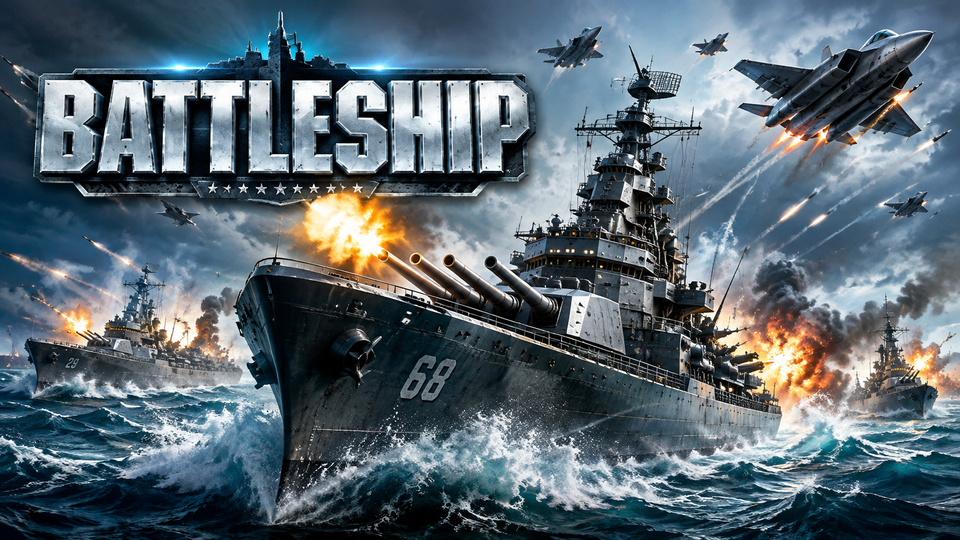
Play Battleship by placing your fleet, searching the enemy grid, tracking hits and misses, unlocking stronger weapons, and sinking every opposing ship.
Battleship is a naval strategy game where two sides hide ships on separate grids and attempt to destroy the opposing fleet. You begin by positioning ships horizontally or vertically, then fire at hidden squares and use every hit and miss to narrow down where the enemy vessels are located. In this browser version, each side receives three guesses during a turn, and continued play can unlock weapons capable of attacking larger areas.
The battlefield is divided into squares, but you cannot see where the opposing ships have been placed. Your first task is therefore defensive: arrange your own fleet in positions that are difficult to predict.
Once both fleets are ready, the battle changes into a search-and-deduction game. You select squares on the enemy grid and receive information about the result. A successful attack is marked as a hit. Missing confirms that the selected square does not contain part of a ship.
A ship remains active until every square occupied by that vessel has been hit. When the complete ship has been revealed, it is considered sunk. Your objective is to locate and destroy the entire enemy fleet before the opponent does the same to yours.
The key is to turn every shot into information. Missing a target still tells you something useful because that square no longer needs to be considered during later turns.
The documented browser controls use the left mouse button throughout the game, keeping the interaction focused on ship placement and grid selection rather than keyboard commands.
The placement phase determines how difficult your fleet will be to discover. Every player receives ships of different sizes, and each vessel occupies several connected squares on the grid. Ships can be positioned horizontally or vertically.
Avoid arranging your entire fleet in one obvious cluster. If several ships occupy the same area, an opponent who discovers one vessel may accidentally find another while checking nearby squares.
It can also help to vary your placement from one match to another. If you repeatedly use similar corners, edges, or patterns, a returning opponent may eventually begin searching those areas earlier.
Random clicking can occasionally find a ship, but systematic searching provides more information from the same number of guesses.
During the early part of the battle, spread your attacks across unexplored sections of the grid rather than concentrating several guesses beside previous misses. The goal is to discover the first square of a hidden ship.
Once you score a hit, your priorities should change. A ship occupies connected squares and is placed horizontally or vertically, so the remaining parts must extend in one of those directions. That makes the spaces immediately above, below, left, and right of the hit much more valuable than another unrelated square.
A hit is the strongest clue you can receive in Battleship. Instead of immediately returning to broad searching, inspect the neighboring squares.
If a second hit appears directly beside the first, you have discovered the ship's orientation. Two horizontal hits mean the remaining sections must continue along that row. Two vertical hits narrow the search to the same column.
From there, continue attacking along that line until the ship has been completely revealed. This approach prevents you from wasting guesses in unrelated parts of the board while a damaged ship is already partially located.
A miss is not simply a failed attempt. It permanently removes one square from consideration.
As more misses accumulate, compare the unexplored spaces with the sizes of the ships that remain. If an open gap is too small to contain one of the remaining vessels, there is little reason to keep targeting it while larger unexplored regions are still available. This type of elimination is specifically useful when searching for the last few ships.
This version of Battleship adds progression to the traditional grid-search formula. Completing battles earns XP, which contributes toward increasing your level. As you progress, additional weapons become available.
These weapons can affect larger areas than a standard single-square attack. That makes them especially useful when you have narrowed an enemy ship to a particular region but have not yet identified every occupied square.
Do not rely on larger attacks as a replacement for deduction. A powerful weapon provides greater coverage, but knowing approximately where a vessel is hiding makes that coverage much more valuable.
Leave space between different vessels whenever your layout allows it. If ships are packed together, attacks aimed at one vessel may reveal another one nearby.
At the beginning of the match, spread guesses across the grid to discover a target. Once a hit appears, stop broad searching and switch to checking neighboring squares.
After the first hit, test adjacent squares. A second connected hit reveals whether the vessel is running horizontally or vertically, dramatically reducing the number of positions you need to examine.
Ship size matters when evaluating unexplored sections. If only a large vessel remains, tiny isolated gaps cannot contain it. Focus your guesses on spaces where the remaining ship could realistically fit.
When larger weapons become available, use them where previous hits or remaining grid space suggest a ship is likely to be located. Covering an informed target area is more efficient than firing powerful attacks randomly.
If you enjoy Battleship's combination of targeting, tactical decisions, and combat, try these related games on YaloGames:
For another game with a strong naval connection, start with Ship Smasher. If the tactical combat side interests you more, Fortress Clash and Steel Legion offer different battle-focused experiences.
Your objective is to discover where the opponent has hidden their ships and hit every section of every vessel before they destroy your fleet.
No. The documented game rules allow ships to be placed horizontally or vertically.
In this browser version, each side receives three guesses during a turn.
A ship is sunk after every grid square occupied by that vessel has been successfully hit. In the browser version, the complete destroyed ship is revealed once this happens.
The browser version described here is credited to Hasbro.
Battleship rewards careful searching more than random firing. Spread your early guesses across unexplored water, immediately investigate the squares around a successful hit, and use misses to rule out locations where the remaining ships cannot fit. As new weapons become available, combine their wider attack areas with the information already revealed on the grid. The commander who interprets those clues most efficiently has the strongest chance of sinking the enemy fleet first.
LIVE CHAT
No messages yet. Start the conversation.
Log in to join the chat.
Login