Loading game
Preparing player
Loading game
Ready to play
Play Backgammon online, roll two dice, move 15 checkers, hit exposed blots, re-enter from the bar, bear off first, and plan every move carefully.
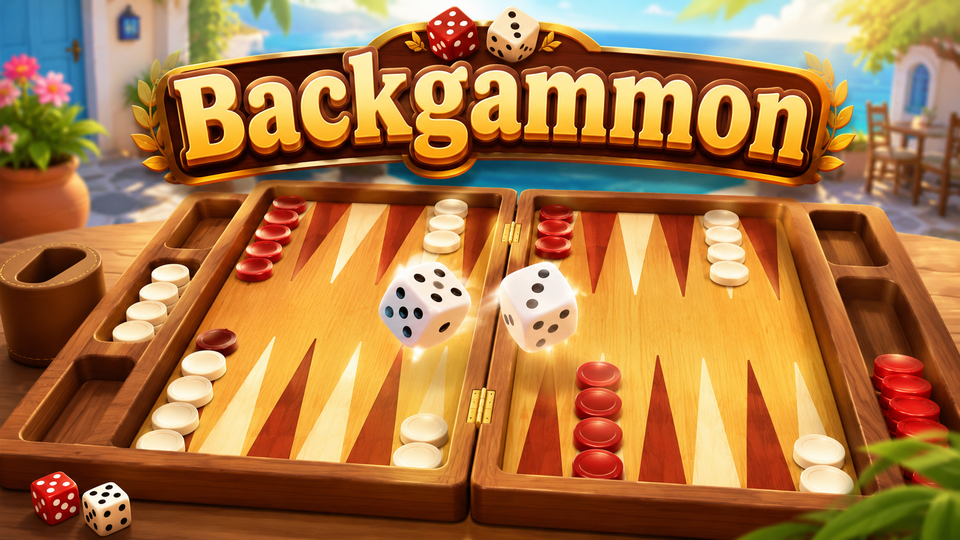
Backgammon is a two-player strategy board game where each side moves 15 checkers around a 24-point board according to two dice. Your objective is to bring every checker into your home board and then bear them off before your opponent. Dice determine how far you can move, but decisions about blocking points, leaving exposed checkers, hitting opponents, and choosing how to use each roll determine how efficiently you complete the race.
Both players begin with 15 checkers arranged in fixed starting positions. They travel around the board in opposite directions toward their respective home boards. Each turn uses the values shown on two dice to determine the available movement.
A checker can move onto an empty point, a point occupied by your own pieces, or a point occupied by exactly one opposing checker. You cannot land on a point containing two or more opposing checkers.
The first player to move all 15 checkers into the home board and successfully remove every checker from the board wins.
The Code This Lab browser version uses mouse-based interaction throughout the game. Its Classic Backgammon edition includes play against the computer and local play against a friend.
Each die represents a separate movement value. If you roll 3 and 5, for example, you can potentially move one checker three points and another five points, or move the same checker through two legal movements totaling eight.
The intermediate position still matters when one checker uses both values. You cannot treat the total as one unrestricted move if one of the required landing points is blocked.
Standard backgammon rules also require you to use both dice when legal moves are available. If only one value can legally be played, you use the move that the rules allow.
Rolling identical numbers gives you four moves of that value instead of two. A roll of 4-4 therefore provides four separate four-point movements, assuming the board position allows all of them.
Doubles can produce major changes because they provide twice the usual number of movements. They can help you escape dangerous positions, build several protected points, advance a group of checkers, or remove multiple pieces during bearing off.
A point occupied by two or more of your checkers is protected from an opposing checker landing there. Building these protected positions can restrict the opponent's available movement.
A point containing only one checker is called a blot. Blots are vulnerable because an opposing checker can land on them and send the exposed piece to the bar.
This creates an important tradeoff. Spreading individual checkers can give you more movement options, but too many exposed blots can give your opponent several opportunities to hit you.
If your checker lands on a blot, the opposing checker is hit and moved to the central bar. A player with a checker on the bar cannot continue moving ordinary pieces until the captured checker has successfully re-entered the board.
Re-entry uses the dice and the opponent's home board. The checker must enter through a corresponding open point. A destination occupied by two or more enemy checkers is blocked and cannot be used. If neither rolled value provides a legal entry, the player cannot make another move during that turn.
Because of this rule, hitting a blot can do more than send one checker backward. A strong home-board structure can make that checker difficult to re-enter, costing the opponent valuable turns.
You can begin bearing off only when all 15 of your active checkers are inside your home board. If a checker is later hit and moved to the bar, it must re-enter and return to the home board before bearing off can continue.
A checker can normally be removed when a die matches the point it occupies. For example, a 6 can bear off a checker from the six-point. If you roll higher than your highest occupied point and no checker remains on a higher point, the rules allow you to remove a checker from the highest occupied point instead.
The first player to remove all 15 checkers wins the game.
A single checker can be hit, while a point holding two or more of your checkers cannot be occupied by the opponent. Building protected points reduces your exposure and can interfere with the opponent's route.
An exposed checker may be worth the risk when it creates a valuable position or advances your race, but unnecessary blots give the opponent easy hitting opportunities. Before finishing a move, check how many opposing checkers could reach the exposed point on their next roll.
Hitting an opponent is useful, but not every available hit is equally strong. Prefer moves that send an enemy checker to the bar while also creating a protected point or moving your own pieces closer to home.
Because an opponent cannot land on a point containing two or more of your checkers, multiple protected points can restrict their movement significantly. This becomes especially valuable when an opponent has a checker waiting on the bar.
Doubles provide four movements. Before making the first one, inspect how all four can work together. A rushed first move can block a stronger sequence that would have used every available movement.
If your checkers are already farther along and there is little contact remaining between the two sides, reducing unnecessary blots can be more valuable than searching for aggressive hits. When you are behind, creating contact and hitting opportunities may matter more.
If you enjoy Backgammon's mix of dice, board positioning, and forward planning, try these games available on YaloGames:
For another dice-based board game, start with Snakes and Ladders. If you prefer the strategic side of Backgammon, 2048 and Trap the Cat put more emphasis on planning future positions.
Each player begins with 15 checkers and attempts to move all of them around the 24-point board and off the board before the opponent.
A checker hit while sitting alone on a point is placed on the bar. Its owner must re-enter that checker into the opponent's home board before making normal moves with other pieces.
No. A point containing two or more opposing checkers is closed to your pieces.
You play the rolled number four times. For example, 5-5 gives you four five-point movements when all four can legally be used.
The Classic Backgammon browser game described here was created by Code This Lab. Its documented modes include playing against the computer and challenging a friend locally.
Backgammon combines unpredictable dice with decisions you can control. Strong play comes from protecting useful points, limiting unnecessary blots, recognizing valuable hits, re-entering efficiently after a capture, and planning how both dice work together before moving. Get all 15 checkers into your home board, manage the bearing-off stage carefully, and remove your final checker before your opponent to win.
LIVE CHAT
No messages yet. Start the conversation.
Log in to join the chat.
Login