
Loading game
Preparing player
Loading game
Ready to play
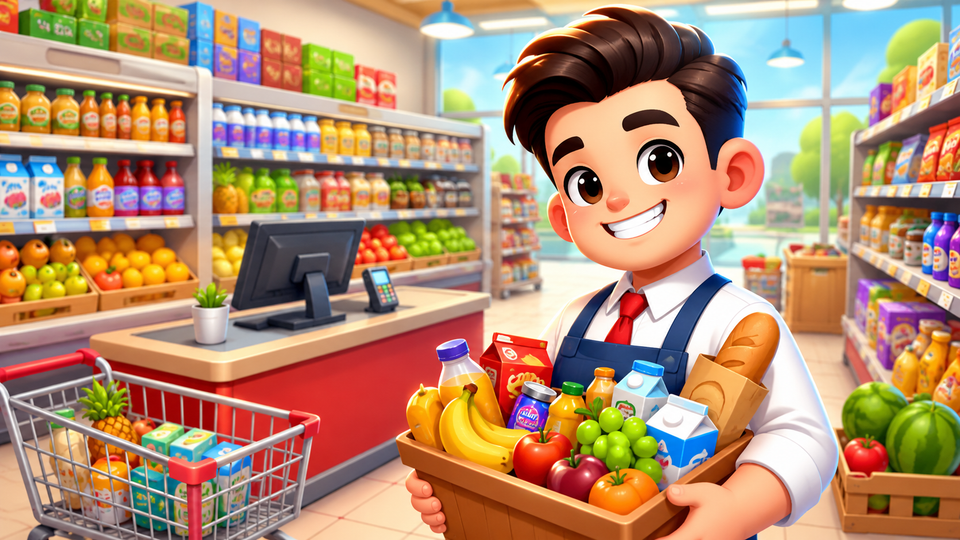
Supermarket Master is a management game where you stock products, serve customers, hire workers, upgrade departments, and grow a small grocery store.
Supermarket Master is a business management game where you begin with a small grocery operation and gradually expand it into a busy retail store. Your responsibilities include improving product sections, keeping goods available, serving customers efficiently, hiring workers, and reinvesting revenue into further growth.
Unlike a supermarket game built around shopping as a customer, this experience places you on the management side of the counter. Progress depends on identifying operational bottlenecks: empty shelves reduce sales, slow checkout service creates queues, and expanding too quickly can leave the store without enough employees to handle the added workload.
Supermarket Master follows the familiar progression of a supermarket simulator but presents it through accessible upgrade and management systems. The store begins with limited products, staff, and selling capacity. As customers purchase goods, the business earns money that can be spent on production, shelves, employee productivity, checkout service, and new departments.
Current game listings consistently describe a loop based on stocking products, improving customer flow, hiring employees, and unlocking additional store areas. The main challenge is deciding which part of the operation should receive the next investment.
The result is closer to a supermarket manager simulator than a detailed first-person cashier game. You supervise the store’s systems and improve their efficiency so the business can serve more shoppers without becoming overwhelmed.
Products are the foundation of the store’s income. If goods are produced too slowly or remain unavailable, customers have fewer items to purchase. Production upgrades help the supermarket maintain a steadier supply as more shoppers arrive.
Do not focus entirely on opening new departments while older counters regularly run empty. Improving an existing product can sometimes produce more reliable revenue than adding another underdeveloped section.
More stock is useful only when the store has enough room to display and sell it. Shelf or counter upgrades increase the amount of merchandise available to customers and reduce the frequency of shortages.
Watch how quickly a product disappears. A fast-selling section may need both stronger production and greater display capacity. Upgrading only one side can simply move the bottleneck elsewhere.
Customers do not generate completed sales until they finish paying. Long checkout queues slow the entire business because shoppers occupy the store longer while new customers continue to arrive.
Improve checkout performance when the payment area becomes more crowded than the product sections. Faster service increases customer turnover and allows the supermarket to handle a larger number of purchases.
You can handle a small store with limited assistance, but expansion creates too many simultaneous tasks for the original setup. Workers become increasingly valuable as the supermarket adds products, customers, and departments.
Hiring employees increases capacity, while salary or productivity upgrades help each worker complete assigned tasks more efficiently. Staffing improvements are especially important before a major store expansion.
Unlocking another department broadens the product range and creates new income opportunities. Depending on the stage, the supermarket may grow from a basic produce operation into a larger store with several types of goods.
Expansion also introduces additional operating costs. New merchandise requires production, space, and employees, so opening everything immediately may slow progress rather than accelerate it.
There is no single upgrade order that fits every stage. The best choice depends on what is currently preventing the store from earning more money.
Consistent income matters more than unlocking the largest possible supermarket immediately. Before purchasing an expensive expansion, observe where customers are waiting and where sales are being lost.
If goods sell out first, invest in stock-related improvements. If products remain available but customers wait to pay, prioritize checkout service. When every section operates slowly, an employee or broad productivity improvement may provide the greatest benefit.
It is also useful to concentrate on one department long enough to make it profitable. Spreading money across many weak sections can leave the entire store operating below capacity.
Opening a new section may look like the fastest route to higher revenue, but it also creates another operation that needs products and workers. Stabilize the current departments before adding more complexity.
A full store can appear successful while customers remain stuck at the register. Completed transactions generate money, so checkout performance is part of the revenue system rather than a minor convenience.
Producing goods faster does not help when the selling area cannot hold them or employees cannot move them efficiently. Match production improvements with the rest of the workflow.
One worker may be enough at the beginning, but a larger grocery store needs more support. Hire before delays affect several departments at the same time.
An available upgrade is not automatically the correct purchase. Watch customer movement, shelf availability, and checkout lines before deciding where the next investment belongs.
Players may search for this title using phrases such as Supermarket Master, super market master, or supermarketmaster. Broader searches including supermarket simulator, grocery store simulator, store simulator, and supermarket game can also reflect interest in this type of retail-management gameplay.
These names describe a wider category, so they should not be treated as alternative official titles. Supermarket Master is the specific game covered here, while terms such as supermarket simulator online may also lead to other store-management games with different mechanics.
The goal is to develop a small grocery store by improving products, serving customers, hiring employees, and unlocking additional supermarket sections.
Maintain enough stock, improve customer-facing departments, and prevent checkout delays. A balanced store can complete more transactions and support greater demand.
Hire when your current workforce can no longer keep products, customer service, and checkout operations running efficiently at the same time.
Not always. First confirm that existing departments have sufficient stock, capacity, and staffing. Expand when the current operation can support the additional workload.
Upgrade the system causing the greatest delay. This may be production, shelf capacity, employee productivity, or checkout speed.
Supermarket Master rewards steady expansion supported by efficient operations. Keep products available, prevent checkout queues from becoming unmanageable, and hire workers before the store’s workload exceeds its capacity.
Reinvest based on what customers are experiencing rather than purchasing upgrades at random. When production, shelves, employees, and checkout service grow together, your small supermarket can develop into a much larger retail business.
LIVE CHAT
No messages yet. Start the conversation.
Log in to join the chat.
Login