Loading game
Preparing player
Loading game
Ready to play
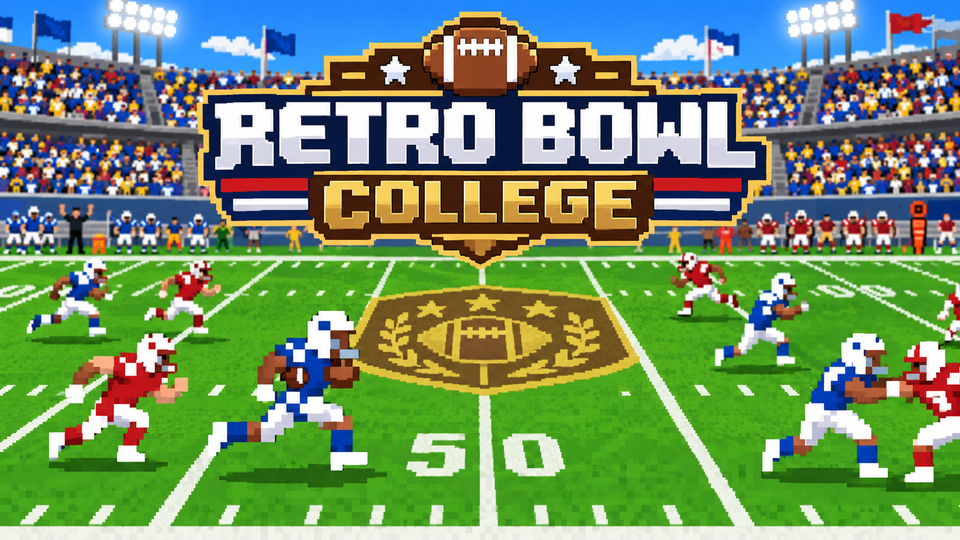
Retro Bowl College combines retro football with recruiting, GPA management, young-player development, passing, rushing, and multi-season college dynasty building.
Retro Bowl College is a retro-style American football management game where you become the head coach of a college program, recruit young players, manage a limited budget, handle student-athlete development, and take direct control of your offense during games. Instead of managing professional contracts and veteran rosters, the college version focuses on short player careers, developing talent, keeping athletes on track, and helping top prospects reach the professional Draft.
New Star Games released Retro Bowl College in September 2023 as the official college spin-off of Retro Bowl. The game offers more than 250 college teams and combines the familiar passing, rushing, kicking, and roster-management systems of Retro Bowl with college-specific challenges.
Your career combines two connected jobs. On the field, you control the offense and try to score through passing, rushing, and kicking. Away from the field, you operate as the head coach responsible for building and maintaining the program.
The management side is more demanding than simply collecting highly rated players. College athletes remain with your program for a limited period, so strong players eventually graduate or move toward the Draft. You must continually develop replacements rather than relying on one roster indefinitely.
Budgets also matter. New Star Games specifically describes Retro Bowl College as a game about managing tight resources while developing young players who can be affected by the distractions of college life.
Browser versions translate the game's original touch-based control system to the mouse and keyboard. Passing uses a click-and-drag motion, while running and kicking use a combination of mouse and keyboard input.
The biggest strategic difference from the original Retro Bowl is the way players enter and leave your team. A professional franchise can keep a star for many seasons if contracts and salary limits allow it. College football requires much more frequent rebuilding.
Your strongest quarterback or receiver may become the center of the offense for several seasons, but eventually that player leaves. A successful program therefore needs a pipeline rather than only a strong current lineup.
When considering new players, focus on actual needs. Recruiting another talented receiver has limited value if your quarterback, defense, or offensive line is the reason the team keeps losing games.
Retro Bowl College adds student-life considerations that are absent from the professional version. New Star Games repeatedly emphasizes the challenge of keeping young players focused while developing them into potential professional prospects. GPA management has also been adjusted in official updates, confirming that academics remain part of the college-management system.
This creates another resource-management problem. A player can be extremely valuable on the field, but you still need to manage the conditions that allow that athlete to remain useful to the program.
Do not judge the roster exclusively through speed, strength, catching, or throwing ability. College management requires you to consider whether your best players can stay available throughout the season.
Passing is based on aiming rather than pressing a button assigned to a specific receiver. Drag to create the throwing path, then release when the aiming line reaches the space where the receiver is heading.
The important detail is that receivers continue running after you begin aiming. Throwing directly at their current position can leave the football behind them or allow a defender to reach it first.
Lead the target instead. Short routes require less anticipation, while deep throws need you to project where the receiver will be when the football arrives.
A pass is not automatically the strongest option. Clicking the handoff indicator gives the football to the running back, while a backward throwing motion lets the quarterback scramble in supported versions.
Running becomes useful when defenders leave space near the line or when you need only a short gain. It can also reduce the risk of forcing a pass into crowded coverage.
Think about down and distance before choosing the aggressive option. A modest gain that keeps the drive alive can be more valuable than attempting a low-percentage deep pass.
The defining management challenge is roster turnover. College players do not remain with one program indefinitely, and the game's official description specifically emphasizes developing prospects and helping them reach the Draft.
This means your team can change significantly from one season to the next. A dominant offense may suddenly lose its most important players, forcing younger athletes into larger roles.
Recruit with future seasons in mind. If an important senior is approaching the end of his college career, adding a younger replacement before the position becomes empty can make the transition much easier.
Retro Bowl College has continued to receive league-structure updates. In August 2026, New Star Games added a League Style feature that allows supported versions to use conference alignments and bowl structures representing different seasons, including 2022, 2023, 2024, and 2026 configurations. A Start Year option can also move a career through those changes over time.
These options are useful for players who want a career structured around a particular era of college football, but the central objective remains unchanged: build a successful program and keep it competitive as players come and go.
Do not spend limited resources simply on the highest-rated athlete available. Check where the current roster is weakest and recruit players who solve those problems.
College rosters turn over quickly. If one position depends completely on an older player, begin preparing the next option before that starter leaves the program.
Aim for where the receiver is running rather than where he is standing. This is particularly important on deeper routes because the football spends more time in the air.
Do not turn every possession into a deep-passing contest. Running plays and short completions can keep the offense moving when the defense protects the deeper part of the field.
College-specific management affects whether your roster remains reliable. Official updates continue to adjust GPA difficulty, so academics are a mechanic worth monitoring rather than treating as background information.
Both games share the same retro football foundation, but the management context is different. Retro Bowl focuses on running a professional franchise, while Retro Bowl College puts you in charge of young players, tighter budgets, college-life issues, recruitment, and preparing prospects for the Draft.
The shorter player cycle changes how you build a dynasty. In the college game, replacing talent is a continuous part of the job rather than an occasional roster adjustment.
If you enjoy American football, passing, scoring, and sports strategy, try these related games on YaloGames:
Retro Bowl College is New Star Games' college football spin-off of Retro Bowl. You coach one of more than 250 programs, develop young players, manage the team, and control offensive plays during games.
Retro Bowl College was developed by New Star Games and originally released in September 2023.
The college version places greater emphasis on young-player development, limited budgets, college-life management, recruitment, roster turnover, and helping players reach the professional Draft.
New Star Games and the current Google Play listing describe a selection of more than 250 college teams.
Yes. New Star Games released a substantial league-structure update in August 2026 and another maintenance update on September 25, 2026.
Retro Bowl College keeps the passing and running mechanics of Retro Bowl but changes the long-term challenge through recruitment, academics, young-player development, and constant roster turnover. Build for more than the current season, recruit before important positions become empty, manage your players as carefully as you manage the offense, and use efficient passing and rushing decisions to turn a developing college program into a consistent championship contender.
LIVE CHAT
No messages yet. Start the conversation.
Log in to join the chat.
Login