Loading game
Preparing player
Loading game
Ready to play
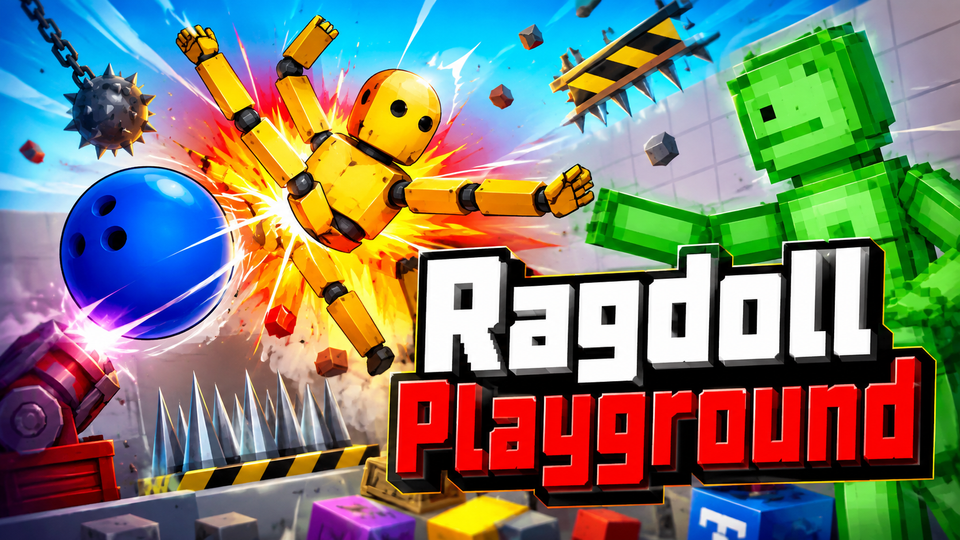
Ragdoll Playground is a 2D physics sandbox where you spawn ragdolls, vehicles and tools, build experiments, and create unpredictable chain reactions.
Ragdoll Playground is a 2D physics-based sandbox game where you choose an environment, spawn ragdolls and objects, then decide what happens next. There is no campaign or fixed win condition. Instead, the gameplay revolves around building setups, activating machinery, moving objects, testing weapons and explosives, and observing how everything reacts to gravity, collisions, pressure, and other forces.
The open structure makes the Ragdoll Playground game closer to a virtual experimentation room than a traditional level-based game. You can construct a contraption carefully, create a chain reaction, test how different objects interact, or simply rearrange the map and start another experiment.
Content note: Ragdoll Playground includes weapons, explosions, physical damage, and graphic effects. Some players may find its violent sandbox content disturbing.
A session starts by selecting an available environment. Instead of spawning into a mission with an objective marker, you enter an open area that acts as a blank workspace for whatever scenario you want to create. Different maps provide different layouts for building and experimentation.
The available object groups include ragdolls, vehicles, machinery, tools, weapons, materials, and explosive items. Some versions also provide additional tools or powers for changing how an experiment behaves.
The desktop controls combine mouse interaction with several keyboard commands. The main functions are consistently listed across current versions of the game.
Because the game is centered on manipulation rather than character movement, learning how to place, rotate, activate, and remove objects efficiently is more important than memorizing a large control scheme.
You can combine objects and then study what happens when the simulation begins. A simple experiment might involve dropping one object onto another, while more elaborate setups can connect several items so that one interaction starts a larger chain reaction. The physics system handles the resulting movement instead of following a scripted animation.
Ragdoll Playground supports construction as well as destruction. Available objects can be positioned together to create improvised machines, structures, traps, vehicles, or other mechanical arrangements. The lack of a required objective gives you room to refine an idea rather than rush toward a finish line.
Characters respond to forces applied through collisions, moving objects, machinery, gravity, and other environmental interactions. Their flexible physics behavior means the same arrangement can produce different-looking reactions depending on positioning and momentum.
The inventory includes weapons and explosives alongside ordinary props and machinery. These can be combined with the physical environment to create more complicated reactions, but their presence is also why the game's graphic content may not appeal to every player.
Ragdoll Playground provides multiple environments rather than one permanent testing room. Current versions reference maps such as Abyss, Blocks, Default, Humongous, Hybrid, Lava, Sea, Slanted, Small, Tiny, Tower, and Void.
The map you choose can change the kind of experiment that is practical. A large open area gives moving objects more room to travel, while confined or unusual environments can make collisions and chain reactions develop differently.
If a complicated chain reaction fails, it can be difficult to determine which component caused the problem. Start with two or three objects, confirm that they interact as expected, and then add the next part of the system.
Ragdoll Playground separates placement from activation. Take advantage of that structure by moving and rotating an interactive object into the correct position before pressing its activation command.
Physics-driven objects need room to move. When several objects begin a scenario already touching one another, the resulting collisions can immediately change the setup. Leaving deliberate gaps makes it easier to understand which interaction caused each reaction.
Do not treat every map as interchangeable. A compact experiment may work well in a smaller environment, while vehicles, large structures, and longer chain reactions benefit from maps that provide more working space.
Old items can interfere with a new test through accidental collisions. Use the delete controls to clear parts of the scene you no longer need rather than stacking several unrelated experiments in the same area.
Ragdoll Playground online refers to the browser-based physics sandbox described on this page. Current game listings identify it as an HTML5 browser game, with versions offered for desktop and touch-capable devices.
Some search results use names such as People Ragdoll Playground or stickman ragdoll playground. These phrases can refer to related ragdoll-sandbox experiences rather than the exact same title. People Playground, for example, is a separate Windows sandbox game developed by mestiez, while Ragdoll Playground is presented as its own browser-based sandbox.
Likewise, searches for Ragdoll Playground 3D should not be confused with the version covered here. The current Ragdoll Playground listings used for this guide describe the game as a 2D physics sandbox.
There is no fixed objective, campaign, or required score. You choose objects and environments, create a scenario, and experiment with the physics system however you want.
Select an item from the object menu, choose where you want it placed, and use E or Q to spawn it in supported desktop versions.
Position the object first, then press F when the selected item supports an activation function.
No traditional level progression is described. The game instead provides multiple environments where you can create your own experiments without a required solution.
No. They share the idea of open-ended ragdoll physics experimentation, but People Playground is a separate PC game developed by mestiez. The browser title discussed here is Ragdoll Playground.
Ragdoll Playground works best when you treat the sandbox as a testing space rather than search for a hidden victory condition. Choose an environment, place a few objects, learn how their physical properties interact, and gradually turn simple tests into larger machines or chain reactions. Because there is no prescribed route through the game, the next experiment is determined by what you decide to build.
LIVE CHAT
No messages yet. Start the conversation.
Log in to join the chat.
Login