Loading game
Preparing player
Loading game
Ready to play
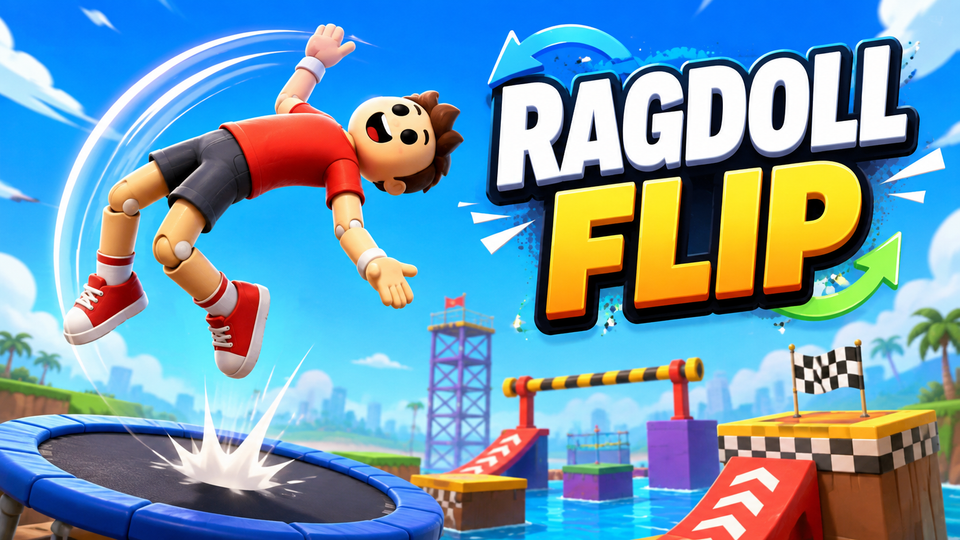
Ragdoll Flip is a physics trampoline game where you perform aerial flips, control rotations, collect coins, and aim for clean landings andlonger streaks.
Ragdoll Flip is a physics-based trampoline game built around jumping, rotating in the air, and landing without losing control. Your character repeatedly bounces from the trampoline while you decide when to rotate, when to release the flip, and how to position the ragdoll for the next landing. Successful tricks increase your score, while coins let you expand what is available as you progress. :contentReference[oaicite:0]{index=0}
The controls are simple, but the physics make every jump a timing challenge. Holding an input keeps the character rotating, while releasing it gives you a chance to straighten the body before touching the trampoline again. Longer trick sequences can produce better scores, but adding another rotation also makes the landing harder to control. :contentReference[oaicite:1]{index=1}
Each attempt revolves around building a steady sequence of trampoline bounces. The character gains height, you perform one or more rotations in the air, and then you try to return to the trampoline in a controlled position.
On supported touch devices, the same basic idea is handled through tapping and holding rather than keyboard input. Browser listings currently describe the game as available across desktop, tablet, a:contentReference[oaicite:4]{index=4}ew0turn565180view2
It is tempting to judge every jump by the number of rotations you complete, but the landing is what keeps a good run alive. A complicated trick that ends in a crash is less useful than a smaller rotation that sets up another controlled bounce.
This creates the main risk-versus-reward decision in Ragdoll Flip. More airtime gives you room for additional rotations, but every extra turn leaves less time to correct your body position. The most reliable approach is to finish the rotation early enough that you can see how the ragdoll is approaching the trampoline.
The character does not behave like a rigid platform-game avatar. Momentum continues through the body, which means a poorly timed input can leave the jumper rotating when you already need to prepare for touchdown.
Holding the flip input increases rotation, while releasing changes the transition into the landing phase. Mouse movement can also help reposition the character over the trampoline. These mechanics make timing and body alignment more important than repeatedly pressing the control a:contentReference[oaicite:5]{index=5}iteturn565180view0
Coins provide progression beyond chasing a higher score. Current game descriptions indicate that coins can be used to open additional characters, trampoline settings, locations, and related upgrades. Different environments give the same core flipping mechanic new s:contentReference[oaicite:6]{index=6}ew0turn565180view1
Do not sacrifice every run for a difficult coin. If reaching one forces your character too far from the trampoline or disrupts a safe landing, continuing the streak can be the better choice. Longer runs naturally give you more opportunities to collect rewards.
If you keep rotating until the trampoline is directly underneath you, there may not be enough time to correct the character's orientation. Start your landing phase while you still have visible airtime.
A controlled single flip teaches you how quickly the ragdoll rotates. Once you recognize that timing, adding another rotation becomes much easier than attempting large trick chains immediately.
A higher bounce gives you more room to rotate and recover. Do not waste that extra airtime by holding the flip input for the entire jump. Use the final part of the ascent and descent to prepare your landing.
Large horizontal corrections can pull the character away from the safest landing area. Small mouse movements are easier to control when you only need to recenter the ragdoll over the trampoline.
Once you have several successful landings in sequence, avoid forcing an unnecessary extra rotation. Consistency keeps the run going and gives you more opportunities to build score and collect coins.
Ragdoll Flip uses a small set of inputs but produces varied results because momentum affects every jump. You are not following a fixed sequence of platforms or completing a standard race. Instead, each bounce becomes a short physics problem: gain height, choose how long to rotate, correct your position, and prepare the body for impact.
That structure makes improvement easy to recognize. Early runs may end after uncontrolled rotations, while later attempts become more deliberate as you learn when to stop flipping and prioritize the next bounce.
Ragdoll Flip is a trampoline-based physics game where you control an airborne ragdoll, perform rotations, collect coins, and try to land safely enough t:contentReference[oaicite:7]{index=7}ew0turn565180view1
Hold the flip input while your character is airborne to continue rotating. Release before landing so the character has:contentReference[oaicite:8]{index=8}iteturn565180view0
Complete controlled tricks and maintain successful landing sequences. More rotations can improve a trick, but they also increase the risk of ending the run.
Game descriptions indicate that coins contribute to unlocking additional characters, locations, trampoline content, and p:contentReference[oaicite:9]{index=9}ew0turn565180view1
Release timing is especially important. Starting a flip is easy; stopping the rotation early enough to line up the next landing is what creates consistent runs.
Ragdoll Flip turns trampoline jumping into a continuous balance between ambition and control. Rotate too little and the trick stays simple; rotate too long and the landing becomes difficult to recover. Learn the rhythm of each bounce, make small positioning corrections, and prioritize clean landings before attempting longer trick combinations.
LIVE CHAT
No messages yet. Start the conversation.
Log in to join the chat.
Login