Loading game
Preparing player
Loading game
Ready to play
Play Mancala by sowing gems around the board, chaining extra turns, setting up captures, and collecting more pieces in your store than your opponent.
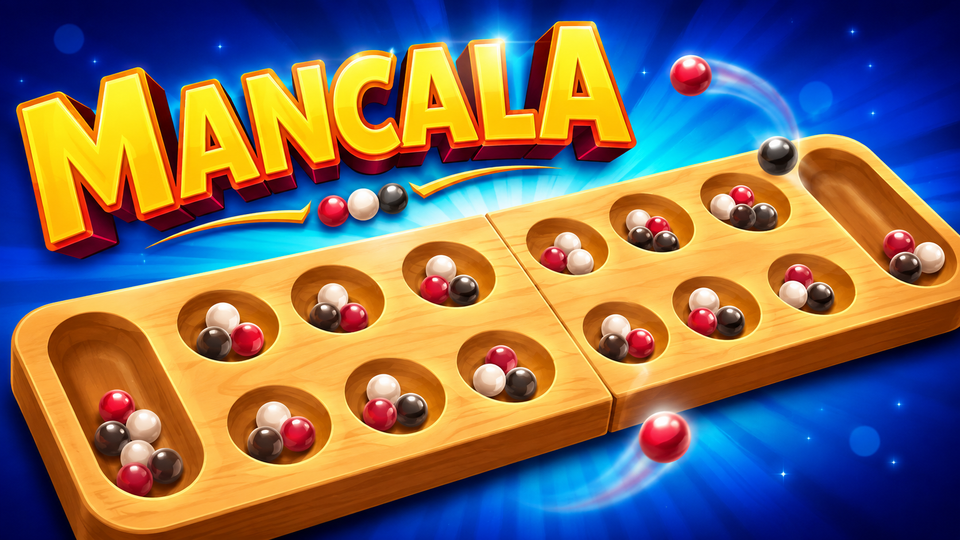
Mancala is a turn-based strategy board game where you collect more gems in your large scoring cup, called a mancala or store, than your opponent. On each turn, you choose one cup on your side, pick up every gem inside it, and distribute them one at a time around the board. Extra turns and captures make the game more strategic than simply moving the largest available pile.
The browser version can be played against the computer or against another player on the same device. The controls are simple, but stronger play requires counting where your final gem will land before selecting a cup.
Each player controls the row of small cups directly in front of them and the large scoring cup on their right. Your objective is to transfer as many gems as possible into your own mancala.
During your turn, select one non-empty cup from your row. All gems in that cup are picked up and distributed one by one in a counterclockwise direction. Your own mancala receives a gem when the distribution reaches it, but the opponent's mancala is skipped.
Most moves end after the final gem is placed, but two special outcomes can significantly change the game: landing the final gem in your mancala gives you another turn, while landing it in an empty cup on your own side can trigger a capture.
The final-gem rule is what makes planning important. Before clicking a cup, count how many gems it contains and determine approximately where the final piece will land.
After you choose a cup, the browser game handles the distribution automatically. You do not manually drag each individual gem around the board.
If the last gem from your move lands inside your own mancala, you immediately receive another turn. This is one of the most important mechanics in Mancala because it lets you make progress without allowing your opponent to respond between moves.
You can potentially create several extra turns in succession. For example, one move may end in your mancala and leave another cup with exactly the number of gems required to reach the store again.
Before choosing a large pile simply because it moves many gems, check whether a smaller pile creates an extra turn. Two carefully planned moves can be much stronger than one move that distributes more pieces but immediately hands control to the opponent.
A capture can occur when your final gem lands in an empty cup on your own side and the directly opposite enemy cup contains gems. The gem you just placed and the gems in the opposite cup are transferred into your mancala.
This makes empty cups strategically important. An empty space is not always a weakness; it can become a capture target if you can later finish a move there while the opposing cup contains a valuable pile.
You should also watch your opponent's empty cups. Leaving a large number of gems directly opposite one can create an opportunity for them to capture the entire pile on a later turn.
Strong Mancala decisions depend on knowing where the final gem will land. You do not need to calculate the entire match in advance, but counting the contents of a cup before selecting it helps you predict the immediate result.
Ask three questions before a move:
This small amount of calculation turns Mancala from a simple gem-moving game into a board-positioning challenge.
The Kalah-style rules used by this version end the game when all of the small cups on one player's side are empty. The player who still has gems remaining in their row moves those remaining pieces into their own mancala. Both stores are then counted, and the player with the larger total wins.
This ending rule can affect late-game decisions. Emptying your side quickly is not automatically good if the opponent still has a large number of gems that will be added to their final score.
Before considering captures or large piles, check whether any cup contains exactly enough gems for the final one to land in your mancala. Extra turns give you another decision before your opponent can interfere.
Do not choose a cup only because it contains many gems. Count its pieces and track the path around the board. Knowing the final landing position tells you much more about the value of the move.
An empty cup on your side can become useful later. If the opposite enemy cup contains several gems, try to arrange a future move that ends in your empty space and triggers the capture rule.
Check the relationship between your cups and the opponent's empty spaces. A large pile that sits directly opposite a capture opportunity can disappear in one move.
Having more gems in your mancala right now does not necessarily mean you control the position. Look at how many gems remain on each side and which player has better opportunities for extra turns and captures.
When either row begins running low, count the remaining gems carefully. If your side empties, every gem left on the opponent's side will be added to their store at the end of the game.
If you enjoy Mancala because every move affects the options available on later turns, try these strategy and puzzle games on YaloGames:
For another game where one decision changes your future options, start with 2048. If you prefer direct board-position strategy, Trap the Cat is another useful choice.
Your goal is to collect more gems in your mancala, the large scoring cup, than your opponent collects in theirs.
Click a non-empty cup on your side. All of its gems are picked up and distributed one at a time around the board in a counterclockwise direction.
If the final gem from your move lands in your own mancala, you immediately take another turn.
If your final gem lands in an empty cup on your side and the opposite enemy cup contains gems, those opposing gems and your final gem are moved into your mancala.
When one side of the board becomes empty, the remaining gems are collected and the stores are counted. The player with more gems in their mancala wins.
Mancala is easy to control but rewards careful counting. Every cup you choose determines not only how many gems move, but also where your final gem lands and whether you earn another turn, create a capture, or leave an opportunity for your opponent. Prioritize useful extra turns, watch the opposite cups for capture possibilities, and pay close attention as the board empties. The strongest moves are usually the ones that improve both your current score and your next position.
LIVE CHAT
No messages yet. Start the conversation.
Log in to join the chat.
Login